On this page
Why does a dog who just loves the lake need watching at all?
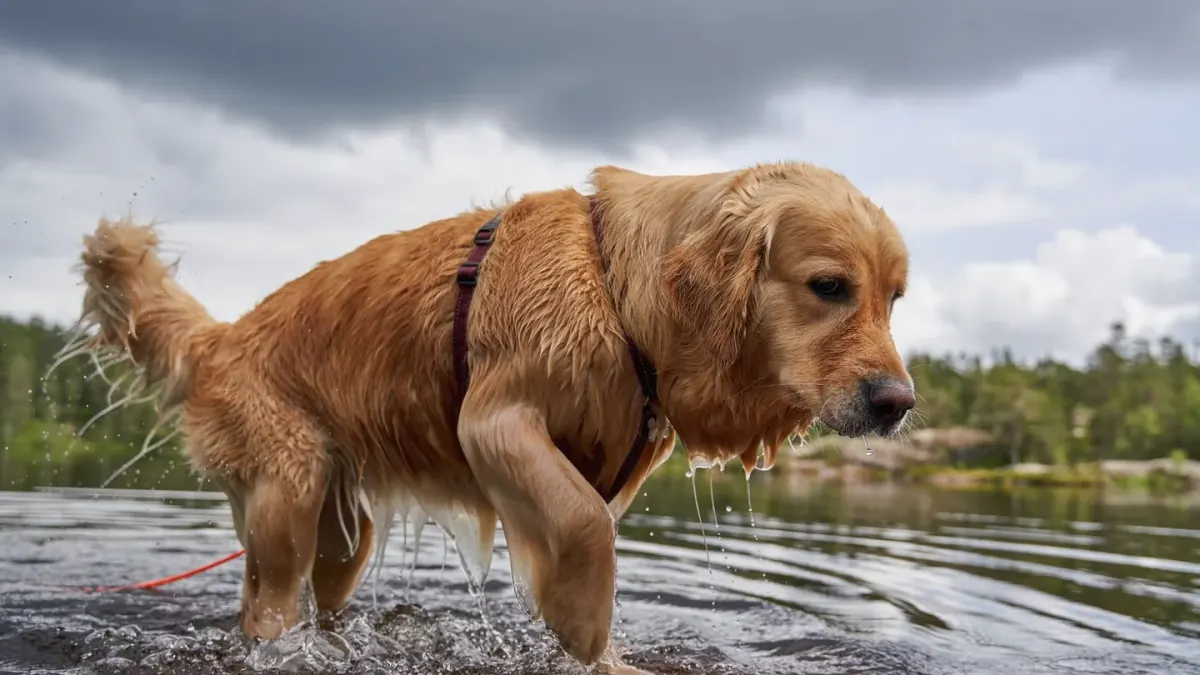
Here’s the part most owners don’t expect: the danger isn’t the water itself, it’s how much of it ends up in the stomach during play. A dog who dives after a ball over and over, or bites at a hose stream with its mouth open, can swallow far more water than it drinks from a bowl in a day. That excess volume dilutes sodium in the blood, and sodium is what keeps fluid balanced between the bloodstream and the cells. When the level drops too fast, water moves into cells — including brain cells — and swelling follows. This is hyponatremia, and it’s the mechanism behind what people casually call water intoxication.
I’ve watched this play out in my own exam room. A twenty-two pound terrier mix, four years old, had spent close to ninety minutes at a lake retrieving a bumper toy nonstop while her owner threw it again and again without a break. By the drive home she was stumbling in the back seat, and by the time she reached me she was glassy-eyed, drooling, and had vomited twice. Her owner’s first instinct was that she’d overheated, because the day had been hot and the dog was panting hard. It wasn’t heat. It was volume — repeated retrieves, minimal rest, a small body with less fat mass to buffer the fluid shift, and a mouth that stayed open in the water on every dive. Bloodwork confirmed low sodium. She recovered with fluid support and monitoring, but the timeline — under two hours from first swim to collapse — is the detail owners underestimate most.
The myth: only pool parties and lake days are risky
Most warnings focus on swimming, and that’s fair — AKC notes that excessive water intake often happens during swimming, diving, or water-retrieving, and even biting at a garden hose or sprinkler stream can overload a dog’s system. But the actual trigger is repeated gulping under play arousal, not the setting. A dog snapping at a sprinkler in the backyard for twenty minutes straight is doing the same thing as a dog diving for a ball at the lake. The pool or lake just makes the volume easier to picture.
The reality: body size and style of play matter more than location
Small and toy breeds carry more risk because their bodies have to process the same volume of swallowed water with far less mass to dilute it across, and lean-bodied dogs have fewer fat cells available to buffer the fluid shift. Dogs that splash with an open mouth and a low head position swallow more than dogs that keep a tight retrieve style. None of that means big dogs are exempt — it means smaller, leaner, more enthusiastic gulpers cross the threshold faster during the same session.
What does water intoxication actually look like in the moment?
Onset is quick — usually within a couple of hours of the swim or play session, not the next day. Early signs are easy to write off as an overtired dog: lethargy, loss of coordination, stumbling, glazed or dilated eyes, drooling, bloating, and vomiting. As sodium drops further, dogs can lose the ability to stand normally, and in severe cases they may struggle to breathe, collapse, seizure, or lapse into unconsciousness. Any dog that goes from playing hard to suddenly wobbly, vomiting, or disoriented after extended time in water needs to be seen immediately — this isn’t a wait-and-watch situation.
Veterinary treatment focuses on correcting sodium carefully rather than quickly. According to Today’s Veterinary Practice, the goal is typically to raise plasma sodium concentration no faster than about 0.5–1 mEq/L per hour, because correcting it too fast carries its own risk of neurologic injury. In practice this means hospitalization, IV fluids, and close monitoring rather than a quick fix at home — ASPCApro describes acute cases as requiring prompt professional intervention with fluid and electrolyte management, sometimes alongside drugs to manage brain swelling in more severe presentations.
There’s no home remedy for a dog already showing these signs. Get to a vet.
A same-day sequence for water play that won’t backfire
- Cap retrieve sessions at 10–15 minutes, then make the dog take a real break on land — not just a pause between throws.
- Watch the mouth, not just the tail wag. An open-mouth, low-head swimming style is your cue to shorten the session, especially in small or lean dogs.
- Let the dog empty its bladder between rounds. Bathroom breaks aren’t just courtesy — they help the body offload fluid it’s already taken on.
- Skip the hose-biting game entirely, or limit it to short bursts with the nozzle at a gentle setting.
- Know the timeline. If a dog goes from swimming hard to stumbling, vomiting, or glassy-eyed within a couple of hours, treat it as an emergency, not fatigue.
If you’re weighing where your dog can safely burn energy near water, it helps to understand what body shape and breed really determine before assuming every dog paddles the same way, and the same planning applies to more structured water outings — see this practical safety guide to kayaking and canoeing with your dog for how professionals pace supervised water time.
Where this leaves owners heading into swim season
The dogs I worry about most aren’t the ones who dislike water — they’re the ones who love it too much to stop on their own. An eager retriever or a small dog with a big thirst drive will keep going past the point their body can safely absorb, because play drive doesn’t come with an internal stopping cue. That’s the owner’s job. I tell clients the same thing I told the terrier’s owner once she’d recovered: the fix isn’t avoiding water, it’s pacing it — short sessions, real breaks, and paying attention to how the dog is swimming, not just how long it’s having fun. Most cases I’ve seen trace back to one long, unbroken stretch of retrieving rather than a single dangerous day at the lake.
If your dog’s daily routine includes a lot of unsupervised backyard water play, it’s worth thinking about where that happens, too — the same pacing logic applies whether you’re at a dog-friendly patio with a water bowl on hand or navigating shared park space where sprinklers or kiddie pools are in play. Build in breaks the same way you would for heat.
Frequently asked questions
How fast do symptoms of water intoxication show up in dogs?
Usually within a couple of hours of heavy swimming, diving, or retrieve play — sometimes sooner in small dogs with intense play sessions.
Can a dog get water intoxication from a bowl or a normal drink of water?
It's very unlikely. Cases almost always trace back to swallowing large volumes during play — swimming, diving for objects, or biting at a hose or sprinkler stream — not from a dog drinking normally.
Are small dogs really more at risk than large dogs?
Yes, relative to body size. Toy and lean-bodied dogs have less mass and fewer fat cells to buffer a sudden fluid shift, so the same volume of swallowed water affects them faster than it would a larger dog.
Sources
- Can Dogs Drink Too Much Water? The Dangers of Water Intoxication — AKC
- Evaluation and Management of the Hyponatremic Patient — Today's Veterinary Practice
- Treating Acute Water Intoxication in Pets — ASPCApro