On this page
Most owners walk up to a dog park gate, see two entrances, and guess. That guess matters more than it looks like it should.
The short answer: if your dog is under roughly 25–35 pounds (parks vary), use the small-dog side, and use it even if your dog “does great” with big dogs at home. Size classification is the standard split — AKC Pet Insurance notes that dog park safety rules typically include age and size restrictions precisely because mixed-size play is where most serious injuries happen. But the reasoning behind that line, and the exceptions to it, are where owners actually get tripped up.
The myth is that the split is about temperament. People assume the small-dog side is for shy or fearful dogs and the large-dog side is for confident, social ones. That’s not what the fence is protecting against. A 65-pound dog with a soft, waggy, entirely friendly play style can still fracture a 12-pound dog’s leg by stepping on it mid-chase, or trigger a startle-and-snap reflex just by moving fast in its direction. The reality is that the split is almost entirely about physics — mass, speed, and how quickly a chase game can escalate past what a small dog’s body can absorb.
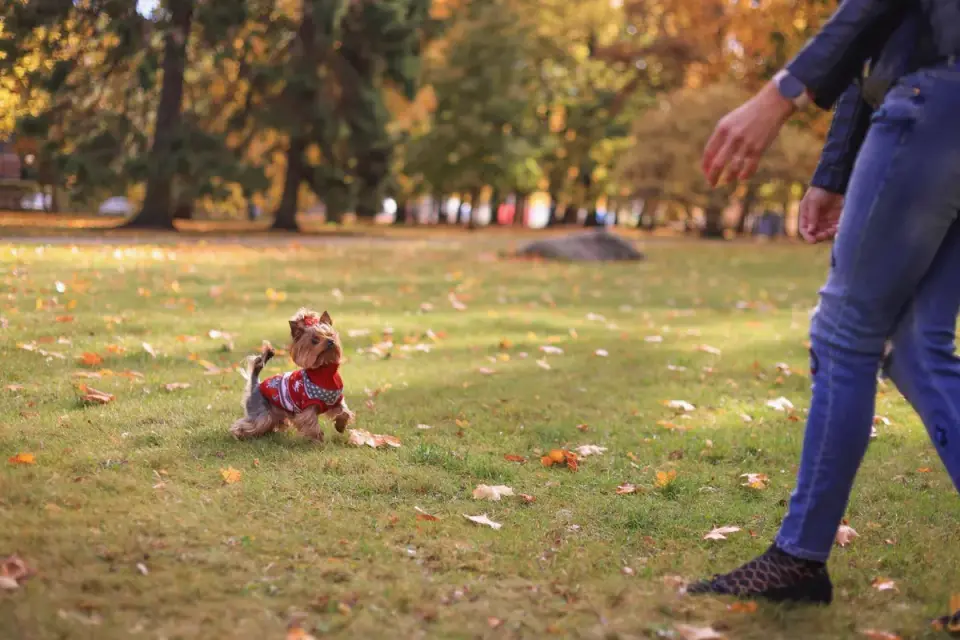
In my practice I’ve seen this play out with a 9-pound Yorkshire Terrier named Biscuit, four years old, whose owner brought him in on a Saturday afternoon after what she described as “totally normal” play at the dog park went wrong. Biscuit had been chasing a tennis ball near a group of three Labrador-mix dogs, roughly 60 to 70 pounds each, who joined the chase. One of them collided with him at a full run near the fence line. There was no growling, no warning — just a fast group game that ended with Biscuit yelping and holding up his front leg. He had a closed radius-ulna fracture that needed splinting and six weeks of restricted activity. The owner’s read on the moment beforehand was that everyone looked happy. That gap — between how play looks and what a small dog’s skeleton can actually tolerate — is the entire argument for using the small-dog side.
The myth of “he’s fine with big dogs at home”
A dog who’s calm around one familiar, known large dog on a leash-free living room floor is not being tested the way he will be at a dog park with four or five unfamiliar large dogs running at open speed on hard-packed dirt or turf. Group chase dynamics change dog behavior. Trainers and behaviorists describe a phenomenon called predatory drift, where ordinary chase play tips into something closer to prey-drive behavior — Vetstreet notes that the greater the size difference between dogs, the greater the risk of a bad outcome if that shift happens, and that it’s most likely to occur when dogs are running, when one dog squeals or struggles, or when several dogs converge on one. This isn’t formally peer-reviewed science; it’s a widely observed pattern among trainers and vets who treat the aftermath. I’d rather an owner overestimate the risk than underestimate it, because the injuries I see from these moments — fractures, punctures, occasionally worse — are not “a scuffle.” They’re orthopedic cases.
That’s also why the small-dog side isn’t a consolation prize. It’s the side built to let a small dog run at genuine speed, off leash, without needing to calculate whether the next approaching dog is going to knock him over. Guidance from park planners backs this structurally: recommendations compiled by Trust for Public Land call for separate enclosures by size as a baseline design standard, not an amenity — the same standard echoed in municipal planning documents like Ann Arbor, MI: Recommendations and Guidelines for Dog Park Site Selection, which notes that separate areas for large and small dogs exist specifically for the protection of smaller dogs.
When the line actually blurs
Size alone isn’t a perfect filter, and a strict “under X pounds” rule misses two categories of dogs. The first is a small-framed but structurally sturdy breed — a Boston Terrier or a French Bulldog, for instance — that may weigh under the cutoff but carries enough mass and a low center of gravity that mixed play is often physically tolerable, provided the dog doesn’t have a brachycephalic airway that limits exertion. The second is the opposite case: a lanky, lightly built medium dog just over the weight cutoff — a young Whippet or a slim Border Collie — that’s technically “large” by scale but moves and plays more like a small dog’s peer. Weight cutoffs are a proxy, not a rule, and if your dog’s build genuinely doesn’t fit the bucket, the safer call is to judge by play style on that visit, not by the number on the gate sign.
A common question owners ask is what to do with a mixed household — one small dog, one large dog, both wanting off-leash time on the same trip. The practical answer most parks and trainers land on is to split the visit: run each dog on its matched side, even if it means two shorter sessions instead of one long one. It’s a minor inconvenience against a fracture bill.
A same-day sequence for choosing correctly
- Weigh your dog if you haven’t recently, or use a reasonable estimate — don’t guess from “he looks big for his breed.”
- Check the specific park’s posted cutoff at the gate; it varies by facility and isn’t universal.
- If your dog is borderline, watch the large-dog side from outside the fence for two minutes before entering. If the play there is fast, chase-heavy, and group-based, default to the small-dog side.
- Once inside, stay close enough to intervene in under three seconds — that’s roughly the window a fast chase interaction takes to turn.
- If you ever see a size mismatch developing inside the “wrong” side (a large dog wandered into the small-dog area, or vice versa), leash up and step out rather than waiting to see how it resolves.
If a fight or a bad interaction does happen despite the right precautions, how you physically separate the dogs matters as much as which side you were on — that’s a separate skill worth learning before you need it, covered in What to Do If a Fight Breaks Out at the Dog Park.
I think about a second dog sometimes, an eleven-year-old Chihuahua mix named Pepper whose owner switched her permanently to the small-dog side after a near-miss rather than an actual injury — a large dog’s shoulder had clipped her at a dead run and knocked her sideways into the fence, no contact injury, just the wind knocked out of her and a badly frightened owner. Nothing broke that day. But the owner told me the moment replayed in her head for weeks, and she never went back to the mixed side again. That’s not an overreaction. It’s a reasonable owner updating her risk model after watching, in real time, how little control either dog had over the outcome once the chase started.
Where this leaves you at the gate
The small-dog side exists because small dogs need room to run at their own scale without absorbing the physics of a much bigger dog’s play. That’s not a judgment on your large dog’s temperament, and it’s not a judgment on your small dog’s confidence — it’s a structural accommodation for the size difference itself. If your dog fits the small-dog cutoff, use that side by default, and only cross over on days when you can verify the large-dog area is calm, small in number, and easy to supervise closely. If your household has both, plan for two shorter visits rather than one mixed one. The goal isn’t to avoid the dog park — it’s to use the version of it built for your dog’s size.
For owners weighing other activity tradeoffs around a dog’s structure and stamina, see Which Breeds Make the Best Running Partners or, for water-based outings, Are All Dogs Natural Swimmers?
Frequently asked questions
What weight counts as a "small dog" at most dog parks?
It varies by facility, but most small-dog areas are designed for dogs under roughly 25–35 pounds; always check the specific park's posted cutoff rather than assuming.
Is it ever okay to bring a small dog into the large-dog area?
Only with close supervision and a clear read on the crowd — if play looks fast, chase-heavy, or group-based, it's safer to use the small-dog side even if your dog seems confident.
Why do trainers worry about size mismatches specifically, not just aggressive dogs?
Because most injuries in mixed-size play come from accidental collisions and chase dynamics, not aggression — a large, friendly dog can still seriously injure a small one without any hostile intent.
Sources
- Dog Park Rules & Safety Tips — AKC Pet Insurance
- Will Large Breed Dogs Gang Up On My Small Dog at the Dog Park? — Vetstreet
- Dog Parks 101: Best Practices — Trust for Public Land
- Recommendations and Guidelines for Dog Park Site Selection, Design, and Management — Ann Arbor, MI