On this page
The walk you’re already doing wrong
Quick gut check before we define anything:
- If your dog is dragging you past every hydrant, mailbox, and tree stump — that’s not bad manners, that’s information-gathering.
- If a 20-minute loop leaves your dog just as wound up as when you left — the walk gave the body exercise but not the brain anything to do.
- If your dog seems “done” with the neighborhood after five minutes but perks up in a new alley or trailhead — novelty, not distance, is what’s driving engagement.
- If you’ve never let your dog stop and sniff one spot for a full 60 seconds — you’ve probably never seen a true sniffari.
A sniffari is a walk where the destination doesn’t matter. The dog chooses the pace, the stops, and the route (within reason, and within your leash length), and the entire point is unhurried, dog-led sniffing. The term itself is a mashup of “sniffing” and “safari,” and it’s become shorthand in trainer and behavior circles for what’s more clinically called a decompression walk — an outing built around environmental processing instead of obedience drills or calorie burn.
The myth: exercise is exercise
Most owners treat a walk as a single unit — distance covered, calories burned, box checked. Under that model, a fast 20-minute loop and a slow, meandering 20 minutes in the same park should produce roughly the same dog at the end. They don’t. A dog’s nose isn’t a passive accessory to a walk; it’s the primary organ doing the work. Sniffing is a rapid, dedicated breathing pattern — short intake bursts distinct from regular respiration — that drives scent information into a part of the brain tied to processing and emotional state, described in olfaction research summarized by the National Institutes of Health. Treating every walk as interchangeable physical output misses that the nose is doing cognitive and emotional work a leg workout can’t replace.
The reality: sniffing is the workout
The reality is that structured sniffing time changes measurable things about a dog’s state. Research on shelter dogs found that olfactory enrichment was associated with improved heart rate variability patterns consistent with reduced physiological stress, a finding reported by the National Institutes of Health. Separately, a review of canine olfaction in cognitive and emotional processing, published via ScienceDirect, describes sniffing behavior as a direct, observable window into a dog’s cognitive engagement and welfare state — not just a distraction to be corrected on leash.
As a veterinary nutritionist and sports-medicine specialist, I think about a dog’s daily routine the same way I think about a feeding plan: what’s the input, and what’s it realistically doing for the animal. A 20-minute brisk loop is cardiovascular input. A 20-minute sniffari is a different input entirely — closer to mental work than physical conditioning — and dogs that get plenty of leash exercise but zero unstructured sniffing time still frequently present with restlessness, leash reactivity, or what owners describe as a dog who “can’t settle.” You can’t substitute one for the other and expect the same result.
Consider a 4-year-old Labrador retriever, 68 pounds, whose owner reports pulling on every walk despite twice-daily 30-minute leash sessions. Three weeks into replacing one of those daily walks with a 20-minute sniffari on a long line — no destination, no pace pressure — the owner reports the dog is settling within 10 minutes of returning home instead of pacing for an hour. Nothing about the dog’s physical exercise volume changed; what changed was giving the nose a job with no interruption.
A same-day sequence to run your first one
You don’t need equipment you don’t already own, just a shift in expectations.
- Pick a low-traffic route, ideally somewhere with grass, curbs, and varied surfaces — not a straight sidewalk stretch with nothing to investigate.
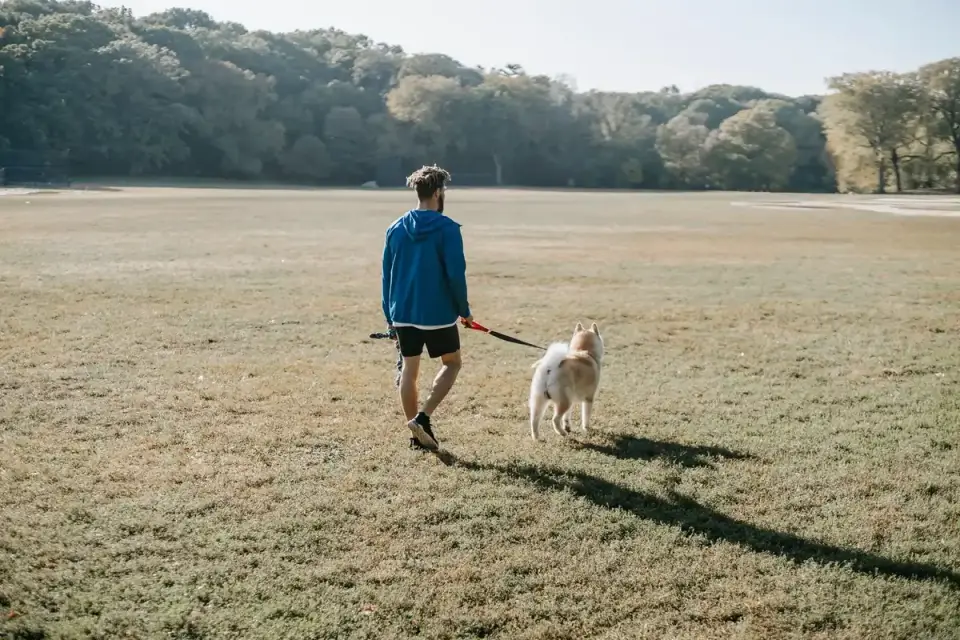
- Swap to a longer leash or long line (10–15 feet is common) so your dog can move off the direct path without you correcting every deviation.
- Drop the pace entirely. If your dog stops to sniff a fence post for 45 seconds, let it run its course. You’re not walking anywhere in particular.
- Watch for a natural finish, not a fixed clock. Some dogs decompress fully in 15 minutes; others want 40. A dog that starts trotting with loose body language and a relaxed tail is usually signaling it’s had enough input.
- Skip the training cues. This isn’t the walk for “heel” or recall drills — save structured work for a separate session so the dog learns the difference between the two modes.
It’s a small shift in behavior, but it’s not a small shift in what the walk does.
Where this breaks down
Here’s the part that complicates the clean recommendation: a sniffari isn’t automatically calming for every dog, and pretending otherwise sets owners up to misread what they’re seeing. A young, under-socialized dog in a novel, scent-dense environment can get more aroused, not less — nose down, body tense, refusing to disengage from a single spot. That’s not decompression; that’s fixation, and it looks similar enough on the surface that owners miss the distinction. The fix isn’t more sniffing time, it’s a calmer, more familiar route until the dog’s baseline settles. A sniffari is dog-led, but “dog-led” doesn’t mean unsupervised — you’re still the one deciding when a stop has stopped being useful.
That nuance matters for dogs recovering from orthopedic issues, too. A 9-year-old mixed-breed dog three months post cruciate ligament surgery, cleared for light leash walking but not off-leash roaming, still benefits from a sniffari’s mental engagement — but the long line needs shortening and the pace needs a floor, not just a ceiling, since standing still and pivoting repeatedly to sniff can load a healing joint in ways a straight-line walk doesn’t. What’s low-impact for one dog isn’t automatically low-impact for another; the format has to be adjusted to the body doing it, not just the brain enjoying it.
Sniffaris also aren’t a substitute for structured physical exercise in a dog that genuinely needs cardiovascular output — a young, high-drive Canicross partner or a dog training for dog park recall reliability still needs dedicated conditioning sessions. Think of a sniffari as one tool that covers mental load, not the whole toolkit.
Building it into the week
A sniffari doesn’t need to replace every walk — most owners get real value from swapping in one or two a week alongside regular exercise, the same way you’d rotate a swim day into a swimming routine or a patio outing at a dog-friendly patio into a weekend plan. Dogs coming off a stressful event — a vet visit, a boarding stay, a loud holiday weekend — are often the ones who benefit most from an unhurried, nose-first outing before returning to a normal exercise schedule.
So the real question isn’t whether your dog needs a sniffari. It’s whether you’re willing to stand still for 45 seconds while your dog reads a fence post like it’s the morning paper — what would change if you did?
Frequently asked questions
Is a sniffari the same thing as a decompression walk?
They're generally used interchangeably. "Sniffari" describes the sniffing-first format; "decompression walk" is the broader behaviorist term for an unstructured, dog-led outing focused on lowering arousal rather than covering distance.
How long should a sniffari last?
There's no fixed number — many owners find 15 to 40 minutes works, with the natural end point being loose body language and a dog that seems ready to head home rather than a clock running out.
Can a sniffari replace my dog's regular exercise?
Not for a dog that needs real cardiovascular output. Treat it as an addition that covers mental engagement, not a substitute for structured exercise like running or fetch.