On this page
Maya found out her Australian Shepherd puppy, Biscuit, was deaf during a routine wellness visit, not because Biscuit seemed distressed. He startled easily, ignored his name from across the room, and slept through the doorbell — all things Maya had chalked up to a stubborn streak. A hearing test confirmed bilateral deafness, and her trainer’s first piece of advice reframed the whole project: stop thinking about what Biscuit can’t hear, and start building a vocabulary he can see.
That shift is the core of how owners train a deaf dog, and it works whether the dog was born deaf or lost hearing later in life.
Why Some Dogs Are Born Deaf
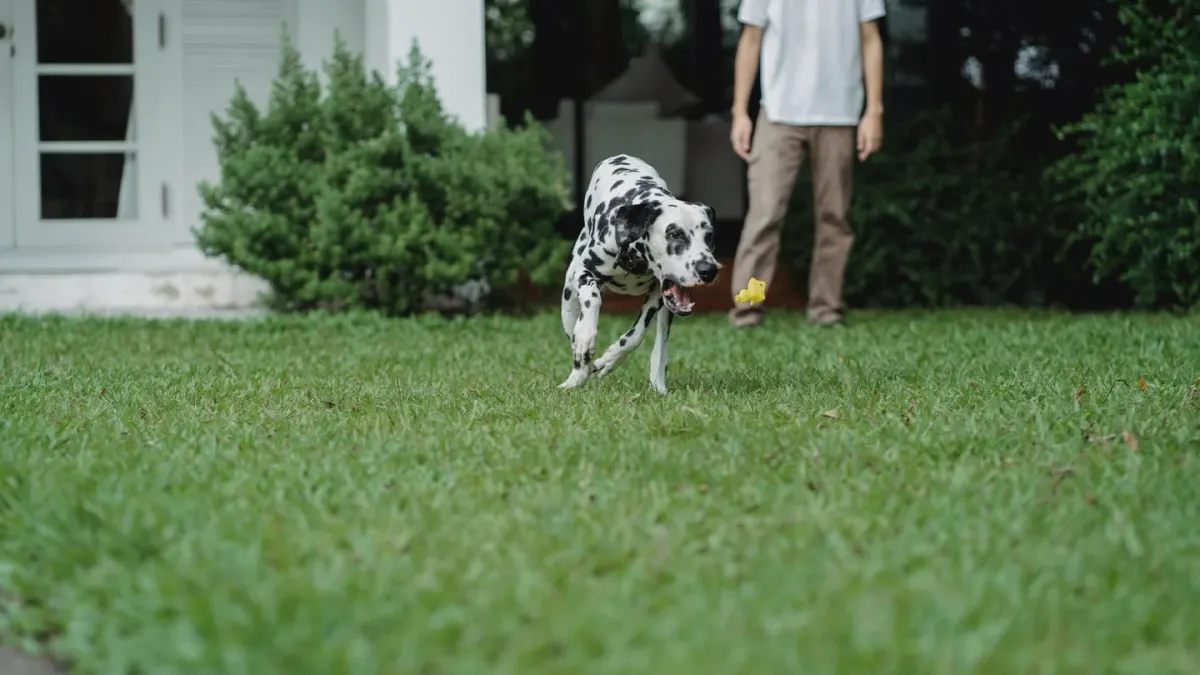
Congenital deafness in dogs is most often linked to two pigmentation genes, merle and piebald, which affect pigment cells in the inner ear as well as the coat. According to the LSU School of Veterinary Medicine, breeds carrying these genes can show markedly higher rates of hereditary hearing loss, and prevalence varies widely by breed and coat pattern. A PubMed-indexed study of 153 privately owned merle dogs found deafness in roughly 9% of the group overall, with dogs carrying two copies of the merle allele significantly more likely to be affected than those carrying one. Dalmatians, white Bull Terriers, and other predominantly white-coated breeds show some of the highest documented rates.
None of this means every merle or white puppy will lose hearing. It means breed and coat pattern are useful clues, not a diagnosis.
Confirm Deafness Before You Begin Training
A dog that ignores cues isn’t automatically deaf — it may be distracted, undersocialized, or hard of hearing in only one ear. A veterinarian can run a brainstem auditory evoked response (BAER) test, the standard diagnostic tool described by the American Kennel Club, to confirm whether hearing loss is partial, complete, or affects one ear versus both. Getting a clear diagnosis first prevents owners from building an entire training plan around the wrong assumption.

Build a Marker Signal First
Before teaching commands, most trainers establish a marker — a single, unmistakable gesture that tells the dog “that behavior earned a reward,” the same role a clicker or the word “yes” plays for a hearing dog. A thumbs-up held at chest height is a popular choice because it’s easy to repeat identically every time. Teach it by flashing the signal, then immediately delivering a treat, repeated in short bursts until the dog’s eyes brighten at the gesture alone. The VCA Animal Hospitals training resources note that this pairing step should happen dozens of times before the marker is asked to do any real work.
Once the marker is reliable, everything else — sit, stay, come, down — is built on top of it the same way verbal cues are built on a clicker.
Core Hand Signals Every Deaf Dog Should Know
Keep each signal visually distinct so the dog isn’t guessing between two similar hand shapes. A flat palm pushed downward for “down,” an open hand raised for “stay,” and a beckoning sweep of the arm for “come” give the dog three gestures that don’t overlap. Consistency matters more than elegance here — a signal invented on the spot works fine as long as it’s used identically every session. Short, frequent sessions of a few minutes, several times a day, tend to hold a dog’s focus better than one long drilling session.
Use Touch and Vibration to Get Attention First
A hand signal is useless if the dog isn’t looking at you, so the earlier skill is teaching the dog to check in. A light touch on the shoulder, a foot-stomp the dog can feel through the floor, or a vibration collar the dog has already learned to associate with a treat are all common ways to prompt that glance. Vibration collars are not the same as shock collars; they’re introduced gradually, paired with treats at low intensity, until the vibration itself predicts something good.
Safety Routines for Daily Life
A deaf dog can’t hear a car, a bike, or a recall cue at a distance, so daily habits carry more weight than they would for a hearing dog. A securely fenced yard, a leash in unfenced or unfamiliar areas, and a habit of approaching the dog where it can see you coming (rather than from behind) all reduce startle-related bites and close calls. Some owners also condition the dog to a vibrating collar specifically as a long-distance recall backup.
Common Mistakes to Avoid
The most frequent misstep is inconsistency — using one hand shape for “sit” on Monday and a slightly different one on Friday. The second is skipping the marker-signal foundation and jumping straight to commands, which leaves the dog with no way to know it did the right thing. The third is assuming a deaf dog needs a fundamentally different training philosophy; the mechanics of reward-based learning are the same, only the delivery channel changes from sound to sight and touch.
Biscuit is two now, and Maya says the hand-signal vocabulary they built in those first few months — thumbs-up, palm-down, an arm sweep for “come” — still runs their whole relationship. The dog never needed to hear a word. He needed a clear signal and a reason to trust it.
Frequently asked questions
Can a deaf dog be trained as well as a hearing dog?
Generally yes. Deaf dogs learn through the same reward-based mechanics as hearing dogs; they simply need a visual marker and hand signals in place of a clicker or verbal cue word.
How do I get a deaf dog's attention if it's not looking at me?
Common options include a gentle touch on the shoulder, stomping so the dog feels the floor vibration, a flashlight flick in a dim room, or a vibration collar the dog has already learned to associate with a treat.
Is it safe to let a deaf dog off-leash?
Off-leash time carries more risk for a deaf dog because it can't hear an approaching car, other dogs, or your recall attempt. Many owners restrict off-leash time to securely fenced areas and keep a leash on elsewhere.
What is the first hand signal I should teach?
Most trainers start with a marker signal, such as a thumbs-up or an open-close hand flash, that tells the dog a reward is coming. Once that's reliable, sit, stay, and come are the next practical signals to build.
Sources
- Deaf Dog Training: How to Train and Care for a Deaf Dog — American Kennel Club
- Teaching and Training a Deaf Dog — VCA Animal Hospitals
- Congenital Deafness and Its Recognition — LSU School of Veterinary Medicine
- Prevalence of Deafness in Dogs Heterozygous or Homozygous for the Merle Allele — PubMed