On this page
Start with the dog you actually have, not the dog on the trailhead poster. Before the first real hike, walk your dog on pavement, gravel, and packed dirt for a few weeks so the pads have time to toughen. Check nails and pad condition after each outing. Carry more water than seems necessary. That’s the short version. The long version is where the mistakes actually happen.
In my practice, the dogs who come in limping after a weekend hike are almost never the ones who did something dramatic. One case that stuck with me: a 4-year-old Lab mix, about 68 pounds, who’d spent the winter mostly in the yard and then went on a 7-mile trail in April because the weather finally turned. By mile 4 he was lagging behind on the climbs, and by the next morning he wouldn’t put weight on his left front paw. The owner had done everything “right” in the moment — brought water, checked for ticks — but the dog’s pads simply hadn’t seen enough rough ground since the previous fall to handle a full day of granite and root systems. Nothing was torn or broken. He was just soft, in the literal sense, and needed two weeks of shorter walks before he was back to normal.
The myth of “he’s a dog, he was born for this”
Owners tend to assume that if a dog loves the outdoors, its body is automatically prepared for whatever the outdoors throws at it. Enthusiasm and conditioning are not the same thing. A dog that’s been mostly sedentary for a season — even a young, structurally sound one — has pads, tendons, and cardiovascular fitness calibrated to that sedentary life. Paw pads especially need time: the skin thickens gradually with repeated exposure to varied, moderately rough surfaces, not all at once on the roughest surface you own. Build distance and terrain difficulty over several weeks rather than jumping from flat neighborhood walks to a rocky ridge hike in one outing.
Breed and body type matter here too, in ways that are worth being honest about upfront. Short-nosed breeds and dogs carrying extra weight face a measurably higher risk with warm-weather exertion, according to the American Veterinary Medical Association. That doesn’t mean a bulldog can’t hike — it means the plan for that dog looks different: shorter distances, cooler hours, more shade breaks, and a much lower threshold for calling it a day.
Heat is the risk most owners underestimate
Panting hard, drooling more than usual, slowing down, and seeking shade are early signs of heat stress, not just “being a dog on a warm day.” The AVMA notes that these can progress to difficulty breathing, vomiting, weakness, or collapse if the dog keeps working past that point. Elderly dogs, dogs with heart or airway conditions, and dogs with thick or dark coats carry extra risk in the heat, per the same AVMA guidance.
The fix is unglamorous: hike during the cooler parts of the day, take breaks in shade on a schedule rather than waiting for your dog to ask, and treat any early sign as a stop-and-cool moment rather than something to push through. If you do end up somewhere hot with a dog that’s struggling, move to shade, offer water, and cool the belly, groin, and paws with cool — not ice-cold — water while you get to a veterinarian; the Cornell University College of Veterinary Medicine notes that internal damage from heatstroke can show up hours after a dog appears to recover, which is why a vet check matters even once symptoms seem to pass.
Water on the trail: bring your own
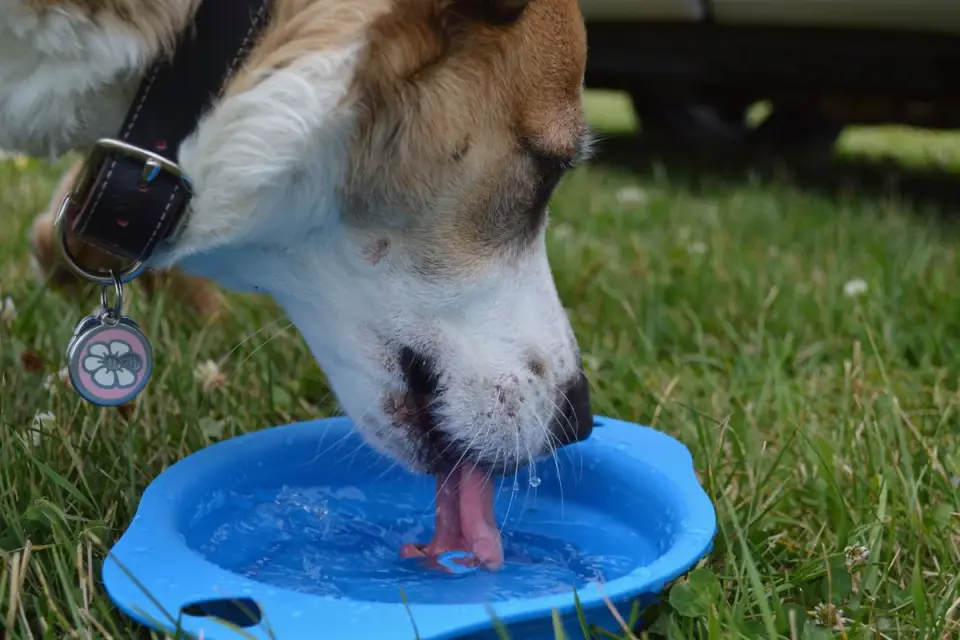
It’s tempting to let a thirsty dog drink from a creek or pond mid-hike, and most of the time nothing happens. But natural water sources can carry Giardia, picked up from feces-contaminated water, soil, or objects, according to the Centers for Disease Control and Prevention. Infection in dogs is often mild or symptom-free, but it can also mean days of loose stool and a vet visit you didn’t plan for. Carrying clean water and a collapsible bowl is a simple habit that removes the guesswork — offer water on the same schedule you’d offer shade, not only when your dog seems visibly thirsty.
If your dog has already had loose stool or a confirmed Giardia diagnosis, the CDC’s general guidance is to limit access to shared outdoor spaces like trails and dog parks until your veterinarian clears them, since the parasite spreads through contaminated waste in exactly those environments.
Paws: the part everyone remembers too late
A short, one-sentence truth: paw pads are specialized skin, and they don’t heal like the rest of a dog’s body.
That’s why conditioning matters as much as it does, and why a pre-hike and post-hike paw check should be as routine as leashing up. Before a hike, run a hand over each pad feeling for cracks, embedded debris, or unusual softness. On the trail, watch for a change in gait, favoring one leg, or excessive licking at a stop — all early tells of an abrasion or something lodged between the toes. After the hike, check again, rinse off grit, and let pads air dry rather than immediately wrapping them. For rocky, hot, or ice-covered terrain, booties are a reasonable tool rather than an overreaction, particularly for a dog that hasn’t built up pad toughness yet.
If you do turn up a cut, burn, or embedded object, clean gently, avoid tight bandaging that can cut off circulation, and treat rest as part of the treatment — pushing another few miles on a sore pad is how a minor abrasion turns into a multi-week recovery.
A same-day sequence before you go
- Walk your dog on varied surfaces for several weeks beforehand if the trail will be new terrain.
- Check the forecast and choose a cooler window; if it’s already hot, shorten the plan or move it to morning.
- Pack more water than you think you’ll need, plus a bowl — skip the creek.
- Do a two-minute paw check before you leave the car.
- Set a mental checkpoint (a landmark, a mile marker) to reassess pace and panting, not just at the end.
- Turn around at the first clear sign of heat stress or a limp — not after the second or third.
Where this leaves you at the trailhead
Later that same Lab mix I mentioned came back for a recheck after his two weeks of rest, and the owner asked the question I hear constantly: was the hike itself the mistake? Not exactly. The mistake was skipping the buildup, not the outing. Once his pads and fitness caught up over the following month — shorter loops first, then longer ones with more elevation — he handled an 8-mile trail without issue. The dog didn’t need to be kept off trails. He needed a few weeks of ordinary walks first.
If you’re weighing whether your dog is ready for a specific hike, the honest answer is usually about preparation, not breed or age alone. A well-conditioned senior can often handle more than an unconditioned young dog. Build the base, watch the early signs, and treat water and shade as scheduled stops rather than emergency measures. For dogs that already love the water as much as the trail, it’s worth reading about what body shape and breed really determine before assuming every hike-adjacent lake is automatically safe. And if your hikes tend to end at a patio table, how to find a dog-friendly patio that’s actually good for your dog covers the same read-the-environment habits that keep the hike itself safe.
Frequently asked questions
How long should I condition my dog's paws before a long hike?
Plan on several weeks of regular walks over varied surfaces — pavement, gravel, packed dirt — rather than a single pre-hike outing. Pad skin thickens gradually with repeated exposure, not all at once.
Is it ever okay to let my dog drink from a stream on the trail?
It's safer to bring your own water. Natural water sources can carry parasites like Giardia from contaminated waste, per the CDC, and it's an easy risk to avoid with a collapsible bowl.
Sources
- Warm weather pet safety — American Veterinary Medical Association
- Heatstroke: A medical emergency — Cornell University College of Veterinary Medicine
- About Giardia and Pets — Centers for Disease Control and Prevention