On this page
Most owners try to teach roll over by dragging a treat in a loop over the dog’s head and hoping the body follows. Sometimes it does. More often the dog just stands up, snaps at the treat, or flops halfway and stalls out staring at you. I tell clients the same thing every time this comes up in an appointment: roll over is not a trick you rush into, it is a trick you build in layers, because you are asking a dog to move through a genuinely vulnerable position on the way to the reward.
Picture a lab-mix named Otis on a Sunday afternoon in someone’s backyard, two weekends into trying to teach roll over with zero progress. He’d go down, and the second the treat crossed over his shoulder he’d pop back up onto all fours and stare at his owner, tail low, clearly unsure what he’d done wrong. Nothing was hurting him. He simply had never been rewarded for the small, in-between step of lying flat on his side, so the leap from “down” to “fully rotated” was too big a jump for him to guess at on his own. Once his owner started marking and paying that side-lie by itself for a few sessions, the rest of the roll came together within a week. That gap, between the trick you picture in your head and the tiny steps a dog’s body actually needs, is where most roll-over attempts stall.
Confirm your dog is a physical candidate first
Before any leash or treat pouch comes out, rule out the dogs who should skip this one. Roll over asks a dog to fully expose their belly, rotate their spine, and briefly lose their footing, which is more demanding than sit or down. The American Kennel Club specifically recommends checking with your veterinarian first, since dogs with spinal, muscular, skeletal, or other physical issues should not be asked to perform it. That includes many seniors, dogs recovering from orthopedic surgery, and short-nosed breeds that can struggle to breathe comfortably while lying flat on their side for several seconds.
If your dog is a healthy adult or a puppy with normal joints, you’re clear to start. If you’re not sure, a quick call to your vet’s office is faster than guessing.
Build the foundation: a fast, reliable down
Roll over is really “down, plus more.” A dog who hesitates on down will hesitate twice as hard on roll over, so spend a session or two making sure down happens within a second or two of the cue, without you needing to repeat it. If your dog is new to structured training at all, our getting-started guide covers the basics of marking and rewarding before you tackle a multi-step trick like this one.
Use small, high-value treats your dog rarely gets elsewhere, chicken or cheese work well for most dogs, and keep sessions to two or three minutes so both of you stay sharp.
The lure-and-shape sequence, step by step
This is the version I walk clients through, broken into criteria your dog can actually hit one at a time instead of one long, blurry motion.
- Ask for down, then hold a treat right at your dog’s nose.
- Pull the treat slowly toward one shoulder, so their head turns to follow it. Most dogs will naturally shift their weight onto that hip.
- Pay that shift. The moment your dog’s weight tips off their hindquarters and onto their side, mark it and give the treat, even if they haven’t rolled at all yet. This is the step most owners skip, and it’s the one that actually teaches the movement.
- Repeat step 3 for several reps across one or two sessions until your dog offers the side-lean quickly and confidently.
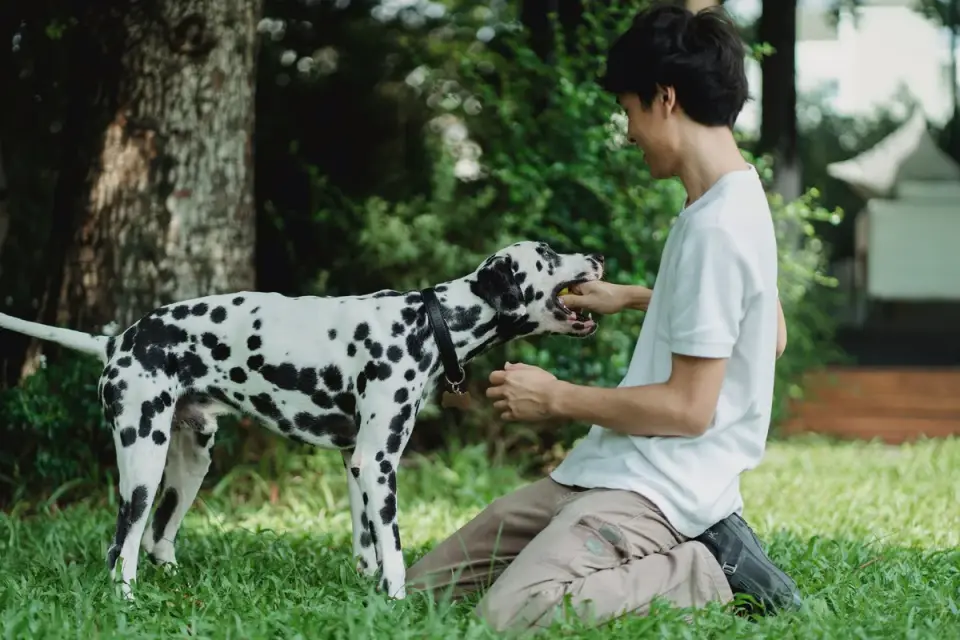
- Extend the lure past the shoulder so the treat pulls your dog fully onto their side, then continues over their back. Reward generously the instant they complete the rotation, even a clumsy one.
- Layer in the cue. Once your dog rolls smoothly for the lure most of the time, start saying “roll over” a half-second before you move the treat.
- Fade the food lure into an empty-hand signal, then gradually reduce the hand motion until the verbal cue alone gets the job done.
Expect the full rotation to take longer than the earlier steps. That’s fine. A dog who reliably offers the side-lean is most of the way there, even if the last quarter-turn takes another week.
Why coaxing instead of forcing actually works better
Some older trick-training advice leans on physically rolling the dog over by hand or applying pressure to their side until they flop. Skip that approach. Beyond the obvious stress it can create in a dog who doesn’t understand what’s happening, current veterinary behavior guidance points the other direction. The American Veterinary Society of Animal Behavior states that reward-based methods outperform aversive or forceful handling for both training effectiveness and the welfare of the dog, with no role for aversive techniques in behavior work. A dog who is lured and rewarded through roll over learns the movement voluntarily, which tends to make the trick more reliable and far less likely to trigger a freeze or flight response down the line.
A dog that trusts the process will offer more, faster, than a dog who is manhandled into position.
Common stalls and how to work through them
The dog stands up instead of lying down. Go back one step. Reward down on its own for a few reps before reintroducing the lure.
The dog gets to the side-lie and stops. This is the single most common stall point. Spend an extra session or two paying that exact position generously before asking for more rotation.
The dog only rolls one direction. Normal. Most dogs develop a dominant side. Once the cue is solid on the easy side, rebuild the same sequence on the other side from scratch, expecting it to take nearly as long as the first side did.
Sessions feel stuck after a week. Shorten them further, two dozen good reps spread across three short sessions usually beats one long, frustrating one, for both of you.
Next step
Practice in short, calm sessions, reward the small in-between movements generously, and don’t rush the full rotation before your dog is ready for it. If your dog shows any reluctance, stiffness, or discomfort at any stage, stop and check in with your veterinarian rather than pushing through it. Once roll over is solid on cue, it becomes a low-key way to work a dog’s body and mind for a few minutes most days, without needing any special equipment beyond a handful of treats.
Frequently asked questions
How long does it typically take to teach roll over?
Most healthy adult dogs with a reliable down and some lure experience can learn a rough version in five to ten short sessions across one to two weeks. Puppies and dogs new to shaping often need longer, and that is normal.
Is roll over safe for every dog?
No. Dogs with spinal, hip, elbow, or other orthopedic issues, along with many seniors and brachycephalic breeds that struggle with mobility or breathing, should skip it. The American Kennel Club recommends checking with a veterinarian before starting.
My dog freezes on their side and won't finish the roll. What now?
That is usually a criteria problem, not a stubborn dog. Go back to rewarding a flat side-lie for several reps before ever asking for the full rotation.
Sources
- How to Teach a Dog to Roll Over — American Kennel Club
- Position Statement on Humane Dog Training — American Veterinary Society of Animal Behavior