
On this page
The first time I examined a Poodle mix whose owner swore she brushed him “every day,” I found a solid pelt of felted fur pressed against his skin from armpit to elbow. The top coat looked fine. Underneath, it was a different story.
That gap between what a Poodle’s coat looks like and what’s actually happening at skin level is the whole problem with home grooming for this breed. Poodle hair doesn’t shed out the way a Labrador’s does — it keeps growing, curling back on itself, and trapping the hair that would normally fall away. Preventive Vet: Surface brushing misses this entirely, and that’s why owners who brush daily still end up at the groomer’s table hearing the word “shave.”
The myth: brushing the surface is the same as brushing the coat
Most owners brush the way you’d brush a straight-coated dog — a few passes over the top, maybe some extra attention where the leash rubs. It looks tidy. It is not the same thing as clearing the undercoat, and for a Poodle that distinction matters more than almost anything else in the routine.
Mats form at the skin, not at the tips. Friction points — behind the ears, in the armpits, under the collar — tangle first, and moisture from a bath or a rainy walk tightens whatever is already there. A slicker brush run quickly over the top coat can leave the whole underlying layer felted while the surface still looks brushed, which is exactly what happened with the dog I described above. The technique that actually reaches that layer is called line brushing, and it’s the difference between a coat that stays manageable and one that ends up shaved down every few months.
What line brushing actually looks like
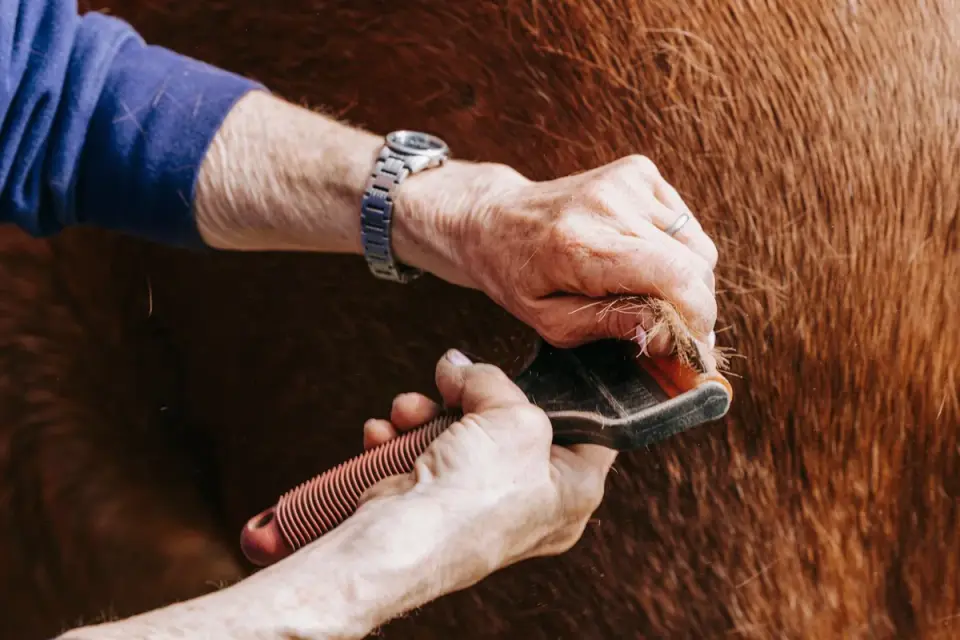
Line brushing means working in thin sections instead of broad strokes. Part the coat down to the skin in a strip about the width of a finger, mist it lightly, then brush that strip from root to tip with a slicker brush before moving to the next section. Groomers describe this as The Dog House: separating the coat horizontally until you can see a clean, straight line of skin, then working outward from there — it’s slower than a quick surface pass, but it’s the only way to confirm you’ve actually cleared a section rather than just smoothed over it.
For a full-grown Poodle in a longer clip, this takes real time — 20 to 40 minutes for a thorough session, depending on coat length. For a shorter “puppy clip” or a dog kept in a summer trim, it’s faster. Either way, doing it in short sections a few times a week beats one long marathon session on the weekend, because mats that are caught small come out with a comb; mats that sit for two weeks often don’t.
A sequence that works in real households
- Mist and section. Dry brushing on a curly coat causes breakage, so a light leave-in conditioning spray or plain water first makes a real difference.
- Line brush in finger-width sections, working from the legs and belly (the highest-friction areas) toward the body.
- Follow with a comb. If the comb catches, that section isn’t actually clear yet — go back with the slicker before moving on.
- Bathe on a schedule, not a whim. VCA Animal Hospitals: Overbathing dries the skin and can increase shedding, while a moisturizing shampoo on a regular cadence supports the skin barrier. For most Poodles, that lands somewhere around every 4 to 6 weeks between professional visits, adjusted for activity and coat length.
- Never bathe over mats. Water tightens tangles instead of loosening them, so any matting found during brushing needs to come out — with a mat splitter, a detangling spray and comb, or scissors as a last resort — before the dog goes anywhere near a tub.
- Book a professional trim every 4 to 6 weeks. Home brushing maintains the coat between visits; it doesn’t replace the clip itself, and stretching that interval is usually where matting gets ahead of an owner.
Why I still land on line brushing over shortcuts
I’ve had owners ask about deshedding tools, detangling sprays used as a substitute for brushing, or simply keeping the coat clipped short year-round to avoid the whole problem. Short clips are a legitimate answer, and for a busy household, I’ll often recommend one honestly — there’s no shame in a “puppy clip” kept short across the board. But for owners who want to keep any length of coat, no spray or tool replaces mechanical brushing down to the skin. The strongest counterargument I hear is that daily brushing sessions are unrealistic for a busy schedule, and that’s fair. My answer is the same one I give for dental home care: a shorter session done consistently beats a long one done rarely, and three ten-minute line-brushing sessions a week will keep most Poodles mat-free where one Sunday marathon won’t.
That’s the piece I come back to again and again in day-to-day practice: consistency matters more than duration. An owner who does five focused minutes on the legs and ears every other day will have an easier coat to manage than one who sets aside an hour once a month. Regular brushing also does something beyond preventing mats — American Kennel Club: it distributes natural skin oils and lets you feel for skin changes early, which is its own quiet benefit. I’ve caught early hot spots and small skin masses on dogs simply because the owner was already running their hands through the coat three times a week and noticed something different under their fingers. That’s not a formal screening tool, but it’s a real, honest side benefit of a habit built around touch.
One owner I worked with had a nine-year-old Standard Poodle, about 55 pounds, who’d always gone to the groomer every six weeks without any brushing at home in between. Around month five of a knee recovery that limited the dog’s exercise, the owner noticed the coat around the hind legs and tail base had gone from curly to matted in a way that hadn’t happened before — the dog was lying down more, and the friction from resting on that area was compounding faster than usual. We adjusted the plan to short line-brushing sessions focused on the hindquarters twice a week, and the mats stopped reforming within about three weeks. Nothing about the coat itself had changed; the dog’s routine had, and the brushing routine needed to change with it.
When to stop and call in help
Mats close to the skin that won’t separate with a comb, mats over a joint, or any mat that seems to be pulling the skin when the dog moves are reasons to stop trying at home. So is any skin that looks red, moist, or odorous underneath a mat once it’s removed — that’s outside what home grooming should be managing, and it’s worth a veterinary look rather than a home fix. For the everyday, non-emergency version of this decision — brush it out yourself or book the groomer — the calculus mostly comes down to time, coat length, and how comfortable you are handling a squirming dog with scissors near the skin; we’ve laid out that decision process in more detail in At-Home Grooming vs a Professional Groomer.
Ear care deserves its own mention here, since Poodles are prone to hair growth inside the ear canal that traps moisture and debris. That’s a separate skill from coat brushing, and it’s worth learning properly rather than folding into a coat session; see How to Clean Your Dog’s Ears at Home for the specifics. Nail care is the third leg of a home grooming routine that’s easy to let slide between professional visits — our Best Dog Nail Grinder guide covers what actually matters if you’re deciding whether to add that to the at-home rotation, too.
Frequently asked questions
How often should I brush a Poodle's curly coat?
Aim for several short line-brushing sessions a week rather than one long weekly session — three to five minutes a day on high-friction spots like the legs, ears, and armpits keeps mats from forming at the skin.
Can I bathe my Poodle if the coat has mats?
No. Water tightens existing tangles, so mats should be worked out with a comb or mat splitter before bathing, not after.
Is a slicker brush enough on its own?
Not by itself. Follow slicker brushing with a metal comb to confirm each section is actually clear down to the skin — if the comb catches, go back over that spot.
Sources
- Caring for Your Dog's Coat: Brushing, Combing, and Mats — Preventive Vet
- HOME BRUSHING GUIDE — The Dog House
- Grooming and Coat Care for Your Dog — VCA Animal Hospitals
- How to Groom a Dog at Home — American Kennel Club