On this page
Quick answer, before the details:
- Basic cues (sit, down, come, loose-leash walking): roughly 4–8 weeks of short daily sessions, per the American Kennel Club
- A cue that holds up around distractions: several more months of practice in new locations
- Manners that feel “done” (no jumping, calm greetings, settling on cue): commonly 6–12 months
- A dog you’d call fully trained, in any environment: often close to the dog’s first full year, sometimes longer for high-energy or working breeds
- The variable that moves this timeline more than any other: session frequency and consistency, not raw hours logged
If you only remember one line from this guide, make it this: training speed is mostly a function of repetition spacing and criteria, not talent, and not luck.
Why “how long” is the wrong first question
Owners ask me this in the exam room constantly, usually holding a leash attached to a dog who just spun in three circles instead of sitting. They want a number. I understand why — a number is reassuring. But a single number hides the part that actually determines the answer: what “trained” means to you.
A dog that sits reliably in your kitchen for a treat is not the same as a dog that sits reliably at the edge of a dog park with another dog barking twenty feet away. Both are real training milestones. They are not the same milestone, and they don’t arrive on the same week.
I’ve watched this play out with a lot of families, but one sticks with me. A couple came in with Otis, an 11-month-old goldendoodle, about eight weeks after starting group classes. He sat and stayed beautifully in the exam room — a small, quiet, low-distraction box he’d practiced in weekly. In the parking lot, leash in hand, he lunged at a delivery truck and forgot every cue he’d just performed for me. The owners weren’t doing anything wrong. They’d simply practiced almost entirely in one context, so the behavior only lived in that context. We spent the next visit talking through practicing the exact same sit-stay in the parking lot, then the sidewalk, then eventually near the dog park fence line — same cue, harder scene, every couple of weeks. By month four, Otis held a stay through the truck.
The myth that six weeks means “done”
Most puppy classes and board-and-train programs run four to eight weeks, and that number gets repeated so often it starts to sound like a finish line. It isn’t one. It’s the point where a dog reliably performs a cue in a low-distraction setting with a familiar handler using a familiar reward. That’s a real achievement — the AKC notes that with consistent practice, dogs usually grasp core commands within about four to six weeks — but it is acquisition, not fluency.
Fluency is a different skill: the cue working when a squirrel crosses the yard, when a toddler runs past, when the dog is tired, hungry, or overstimulated at a birthday party. Behavior researchers describe this as generalization, and it doesn’t happen automatically just because a dog “knows” a cue in one room. It has to be practiced deliberately across new locations, new distractions, and new people. That’s also why a dog can look perfectly trained at home and fall apart at the vet, the groomer, or a friend’s house — the cue was never generalized, so from the dog’s perspective, it’s practically a different cue.
If you’ve already worked through the early stages of potty training a puppy, you’ve likely seen this pattern already: a puppy who’s reliable in the living room but has an accident the first week at a relative’s house. Obedience cues generalize the same way housetraining does — slowly, and only with deliberate repetition in new settings.

What the research actually says about training speed
There’s a temptation to think more training time equals faster results, and that isn’t quite right either. A study of laboratory Beagles working through obedience tasks, reported by ScienceDirect, found that dogs trained one to two times per week, with a single session each time, showed significantly better acquisition than dogs drilled daily with back-to-back repetitions. Cramming sessions back-to-back in one sitting was the worst-performing combination in that study. Spacing mattered more than volume.
That tracks with what I see clinically. Short, spaced-out sessions — five to ten focused minutes, a handful of times a week — tend to outperform a single exhausting hour-long weekend cram session, because the dog isn’t fatigued and the handler isn’t frustrated by minute forty.
Timing matters earlier than most new owners expect, too. Puppies go through a socialization window roughly between eight and sixteen weeks of age when they’re unusually receptive to new people, animals, sounds, and environments. Research on structured training programs introduced during this window, hosted on PMC, found measurable short- and long-term behavioral benefits in puppies who went through it, compared with puppies who didn’t. That doesn’t mean training after sixteen weeks doesn’t work — it clearly does, at every age — but it’s one more reason “how long will this take” depends heavily on when you start, not just how hard you try.
A practical sequence that respects how dogs actually learn
Here’s the order I walk owners through, regardless of the dog’s age:
- Weeks 1–2 — one cue, one context. Pick sit, down, or come. Practice it in the same low-distraction room, five-minute sessions, several times a day. Resist teaching three cues at once; it slows all three down.
- Weeks 3–6 — same cue, new rooms. Move the exact same cue to the backyard, then the hallway, then the driveway. This is where most owners quit early, because it feels like “he already knows this.”
- Weeks 6–10 — layer in mild distraction. Practice with another person in the room, a toy nearby, or a short delay before the reward. If the dog fails, you’ve found the actual edge of what’s been learned — back up one step, don’t push through it.
- Months 3–6 — real-world generalization. Sidewalks, a friend’s porch, the vet waiting room. This is the stage that separates a “trained at home” dog from a dog you can trust in public, and it’s also where format matters — a group class, private session, or online program each generalize differently, since a class gives built-in distraction practice a living room can’t.
- Months 6–12 and beyond — maintenance. Trained behavior fades without occasional reinforcement, especially for cues the dog rarely gets to practice. A few minutes a week keeps it sharp.
If you’re building this out from scratch with a young puppy, the tool you use to mark correct behavior — a clicker versus a verbal marker word — matters less than picking one and staying consistent with it through all five stages above. Switching markers mid-process resets some of the dog’s learning curve.
Where I land, and the counterargument I take seriously
My position: expect roughly six to eight weeks for a dog to acquire the basics, and expect close to a year — sometimes longer for adolescent or high-drive breeds — before you’d call that dog reliably trained across real-world settings. I say this to every family I counsel, because the alternative — letting owners believe six weeks is the whole project — sets them up to feel like they or their dog failed when a behavior they thought was “locked in” falls apart at the dog park in month four. It didn’t fail. It was never generalized.
The strongest counterargument I hear is that some dogs — herding and working breeds especially — pick up cues in days, not weeks, and technically that’s true. I don’t dispute the acquisition speed. What I push back on is treating fast acquisition as proof the dog is done training. A border collie who learns “down” in one afternoon still needs the same months of generalization work as a slower learner; the shortcut only exists at the front end, not the back end. I’ve had owners of quick-learning breeds skip that generalization phase because the dog seemed so sharp, then come back frustrated months later that the cue “stopped working” the moment real distractions showed up. It didn’t stop working. It was never asked to work anywhere but the living room.
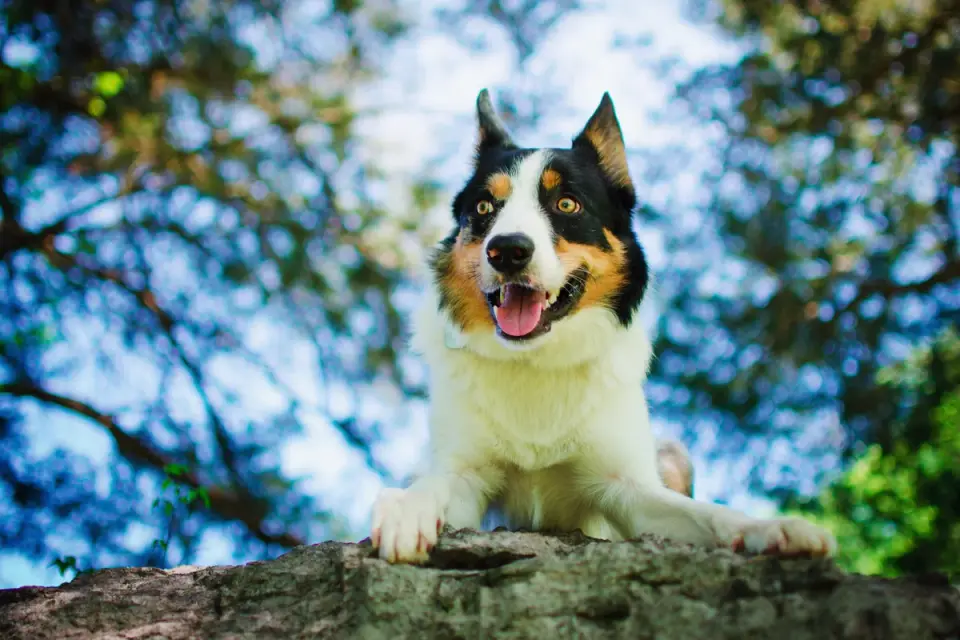
I think about a family I worked with who had Juniper, a 7-month-old border collie mix, about 65 pounds. She learned “down” in a single 15-minute session on a Tuesday evening, which understandably thrilled her owners. By the following week they’d stopped practicing it anywhere but the kitchen, assuming she “had it.” Three months later, at a friend’s backyard barbecue, Juniper wouldn’t hold a down near the grill, and the owners were confused and a little embarrassed. Nothing had gone wrong with her intelligence. The cue simply hadn’t been asked to survive a new room, a new smell, and new people yet. We rebuilt it the slow way — new locations every week or two — and by month five she held it through a full afternoon at that same barbecue the following summer.
The short version
There isn’t one honest number for “how long does it take to train a dog,” because training isn’t one skill — it’s acquisition, then generalization, then maintenance, and each stage runs on its own timeline. Basic cues in four to eight weeks is realistic and well supported. A dog you’d trust anywhere, in any context, is closer to a year of steady, spaced-out practice. If your dog seems to have “forgotten” something you were sure they knew, it’s rarely a memory problem — it’s almost always a generalization gap, and the fix is the same one every time: back up to the last setting where the behavior was solid, and rebuild the distance from there.
Frequently asked questions
Is it too late to train a dog if they're already past the puppy stage?
No. Adult and senior dogs can absolutely learn new cues; it typically just takes more repetitions to override an existing habit than to build a brand-new one in a young puppy.
Why does my dog "forget" a cue we practiced for weeks?
It's almost never forgetting. It's usually that the cue was only ever practiced in one setting, so it hasn't been generalized to the new place, person, or distraction level yet.
Sources
- Basic Obedience Training for Puppies: Where to Start — American Kennel Club
- The effect of frequency and duration of training sessions on acquisition and long-term memory in dogs — ScienceDirect
- Optimising Puppy Socialisation–Short- and Long-Term Effects of a Training Programme during the Early Socialisation Period — PMC