On this page
A family in my hospice practice once described their living room as “controlled chaos”—two kids, a cat, and a dog three days out from a splenectomy, all sharing the same eighteen feet of floor. The dog kept lifting her head at every footstep. That lifted head, that held breath, is the whole reason a quiet recovery room matters more than most owners expect.
The limitation nobody mentions at discharge
Discharge instructions usually cover incision checks, medication timing, and activity restriction. They rarely explain that a healing dog’s nervous system is doing its own work in the background, and that work is disrupted every time a child runs past or a housemate dog trots over to sniff a fresh incision. Sustained low-grade arousal keeps cortisol elevated, and elevated cortisol is associated with slower tissue repair and more variable pain perception in dogs undergoing routine handling and clinical procedures, per a physiological study of veterinary handling published in the National Center for Biotechnology Information. A dog that startles ten times a day isn’t just annoyed—she’s spending recovery energy on vigilance instead of healing.
The 2022 AAHA Pain Management Guidelines for Dogs and Cats frame this directly: non-drug environmental modification sits alongside medication as part of a comprehensive pain management strategy, not as an optional extra. That’s a meaningful shift from the old assumption that a crate and a leash restriction covers it.
The myth worth retiring: “quiet just means less noise”
Owners often solve for decibels—shutting a door, turning down the TV—and assume the job is done. But a quiet recovery room is really about reducing unpredictable stimulation, and sound is only one channel of that. A dog can be in a silent room and still be on alert if a child keeps peeking through a cracked door, or if a housemate cat walks the same hallway every twenty minutes. Predictability calms the nervous system more reliably than silence does.
Set up correctly, the room accomplishes three things at once: it limits sudden movement near the incision or surgical site, it gives the dog a consistent resting surface she doesn’t have to defend or share, and it lets her track who’s coming and going instead of being surprised by it.
Building the room, not just closing a door
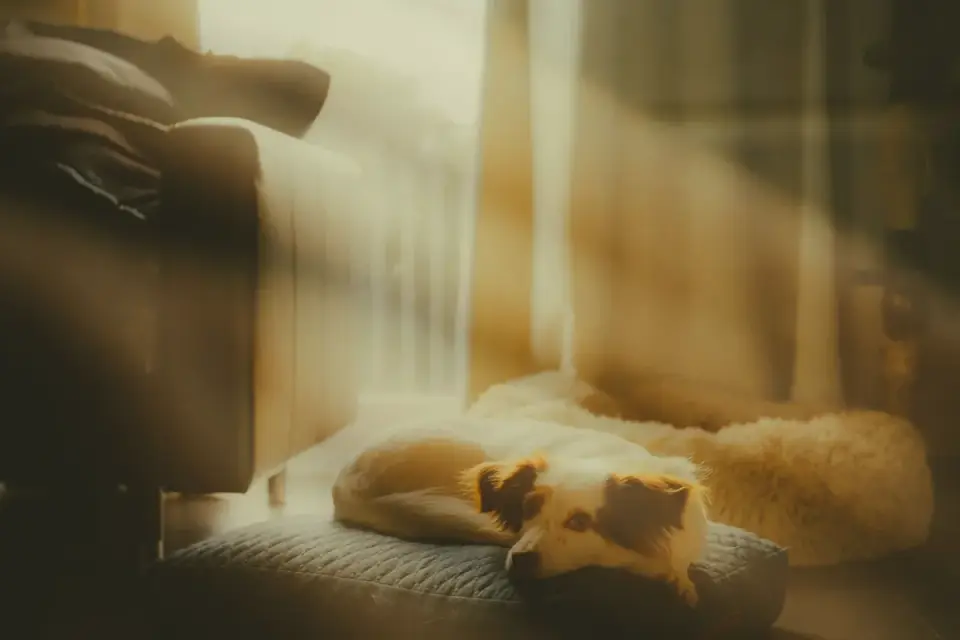
Start with a low-traffic room—a guest bedroom or office works better than a hallway-adjacent den. Use a baby gate rather than a closed door when possible; solid confinement with zero visual contact can raise anxiety in dogs who are used to knowing where their people are, while a see-through barrier lets her monitor the household without being part of it.
Bedding should be supportive and easy to clean, placed away from the doorway swing so a fast-moving door doesn’t startle her mid-sleep. If the recovery involves joint surgery, pair this room setup with the guidance in Bed Ramp Setup for a TPLO Recovery Dog so she isn’t jumping on or off anything inside the space. Water should be reachable without her having to stretch or twist the surgical side.
Kids need a rule, not just a reminder: no entering without an adult, no reaching in to pet through the gate, and no bringing toys or other pets in “just for a minute.” That last one is the rule families break most, usually out of good intentions—a child wants to comfort the dog, and comforting turns into stimulation.
Where the tradeoffs actually live
I worked with a family whose Labrador was recovering from a mass removal, and their first attempt at a quiet room was technically correct—closed door, dim lighting, orthopedic bed—but they’d put it at the end of a hallway their two boys used as a racetrack to the backyard. The vibration and thudding footsteps came through the wall every few minutes. The dog never fully settled, and her appetite stayed picky for longer than expected. Moving the bed to a room off the kitchen, further from foot traffic, made a visible difference within two days. The room design mattered less than where it sat inside the house’s actual traffic pattern.
There’s a real tension, though, between total isolation and the dog’s need to still feel like part of the family. Some dogs, especially ones with separation anxiety history, decline faster when fully cut off from their people, even if it reduces physical stimulation. In those cases I favor a modified confinement plan—covered in A Confinement-and-Comfort Plan for Strict Rest Orders—where the dog stays in a visible but low-stimulation part of the home, with scheduled calm visits rather than open access.
Temperature is the piece owners forget most. A senior dog or a small-breed dog recovering in a room that’s cooler than the rest of the house may guard against movement simply because she’s cold and stiff, which reads as pain but is partly thermal. If that applies, borrow from A Warming Setup for a Senior Dog That’s Always Cold and Draft-Proofing a Cold Room for a Small or Senior Dog before assuming the discomfort is purely surgical.
One consideration surprises most families: the “quiet room” sometimes needs to change over the course of recovery. A dog who tolerates a busier room in week one, while heavily medicated and mostly sleeping, may become more reactive to noise in week two as sedation wears off and she’s more aware of her surroundings. I ask owners to reassess around day four or five rather than assuming the initial setup still fits.
Where I land
I open most of these conversations the same way—with the dog’s comfort and the family’s worry, because those two things are almost never separate. A quiet recovery room isn’t about banishing a dog from the household; it’s about giving her nervous system fewer decisions to make while her body does the harder work of healing. The strongest counterargument I hear is that isolation itself is stressful, and for some dogs that’s true. But a predictable, low-stimulation space with scheduled connection tends to outperform full access to a busy household, especially in the first week. This isn’t a substitute for your veterinarian’s specific activity and pain-management instructions—those still come first.
What would your dog’s version of “quiet” actually require: less noise, fewer surprises, or simply a door she can see through?
Sources
- Effects of Changing Veterinary Handling Techniques on Canine Behaviour and Physiology Part 1: Physiological Measurements — National Center for Biotechnology Information
- 2022 AAHA Pain Management Guidelines for Dogs and Cats — AAHA