On this page
Most owners assume a slicker brush is the only grooming tool they’ll ever need, and for a lot of dogs that’s true. But for a genuinely double-coated dog, a slicker brush alone is working on the wrong layer entirely — it polishes the surface while the real shedding problem sits underneath, out of reach.
I’ve had this conversation more times than I can count during wellness exams. A owner brings in a nine-year-old Golden Retriever, coat looking dull along the flanks, and mentions they brush her “every day, sometimes twice.” What they’re doing is running a slicker brush over the topcoat, which is genuinely useful for surface debris and loose guard hairs, but it never touches the dense underlayer that’s matting against her skin near the hips and behind the ears. By the time I part the coat on exam, there are compacted felt-like mats close to the skin that she’s clearly been tolerating for weeks. The owner isn’t doing anything wrong technique-wise. They just have the wrong tool for what her coat is actually doing this time of year.
What Each Tool Is Actually Built to Do
A slicker brush has a flat or slightly curved head covered in dozens of short, fine wire bristles set close together. It’s designed to glide through the topcoat, lift loose hair before it mats, and smooth out light tangles. It works on nearly every coat type — short, wiry, curly, or double — because it’s addressing the outer layer, not the structure underneath.
An undercoat rake is a different piece of hardware. It has one or two rows of longer, more widely spaced metal teeth built to reach past the topcoat and pull loose, dead hair out of the undercoat itself — the soft, insulating layer that grows in close to the skin on double-coated breeds. According to the What Is a Double Coat, and What Dog Breeds Are Double-Coated? guide from the American Kennel Club, breeds like Huskies, Golden Retrievers, German Shepherds, and Corgis carry this dense undercoat specifically for insulation and weather resistance, and it sheds seasonally in large volumes rather than shedding a little every day.
That structural difference is the whole answer to “which one do I need.” If your dog has a single coat — most Poodles, Maltese, Greyhounds, and similar breeds fall here — a rake has nothing to grab and can scrape uncomfortably against skin that isn’t protected by an undercoat. If your dog has a true double coat, a slicker brush by itself will keep the surface looking tidy while the undercoat quietly builds toward a mat.
The Myth That More Brushing Fixes Everything
There’s a persistent idea that if a dog is shedding heavily, the answer is simply to brush more — more often, more pressure, more passes. That’s only half true, and the half that’s wrong is the part that causes injuries.
Brushing frequency matters less than brushing the right layer. A dog getting daily slicker-brush sessions but no undercoat work can still mat, because the two tools aren’t interchangeable substitutes for each other — they’re sequential steps. The AKC’s own Dog Brushes: How to Choose the Right Dog Brush for Your Pet guide is direct about matching brush type to coat structure rather than assuming one tool scales up to handle every job with more effort.
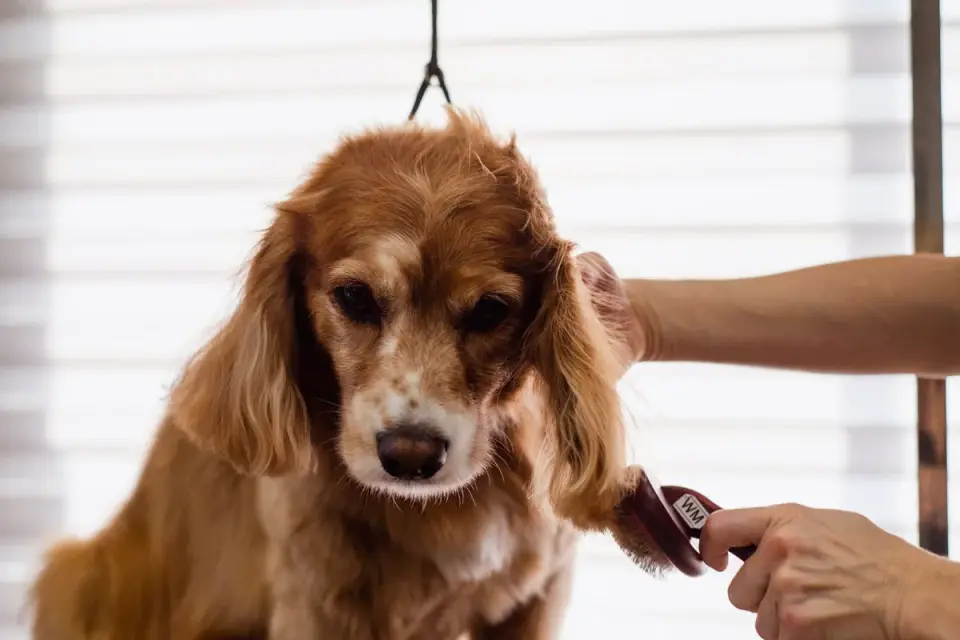
The injury risk shows up when owners compensate for the wrong tool by pressing harder. A slicker brush dragged aggressively over skin, or an undercoat rake used with too much force on a coat that’s already matted close to the skin, causes what groomers call brush burn — a raw, reddened strip that a dog will often lick or chew afterward. A Dogster roundup of vet-approved brushing tools makes the same point from the other direction: the right tool for the coat type reduces the pressure needed to get results, which is part of why matching tool to coat matters more than technique alone.
I’ll be honest about where the evidence gets thin here: there isn’t a controlled study measuring how much grooming-tool mismatch contributes to skin irritation in dogs, so I’m not going to claim a number. What I can tell you from years of exams is that the pattern — surface coat looking fine, undercoat matted, skin underneath irritated — shows up often enough in double-coated breeds during seasonal shedding that it’s worth checking for directly rather than assuming the coat is healthy because it looks smooth from the top.
A Sequence That Actually Works at Home
For a double-coated dog, the order matters more than the brand of tool. Start with the undercoat rake while the coat is dry, working in the direction of hair growth in short, gentle sections rather than one long aggressive pass. This pulls out the loose, dead undercoat before it has a chance to felt against the skin. Follow with the slicker brush over the same sections to smooth the topcoat and catch anything the rake left behind. If you hit resistance with the rake, stop and check for a mat rather than pulling through it — tight mats close to the skin pull on the skin itself the same way a tangle in your own hair does, and that’s a job for scissors or clippers, not more force.
For a single-coated dog, skip the rake entirely. A slicker brush two to three times a week, more often during a seasonal blow-out if your dog has a mixed or transitional coat, is usually enough to prevent surface tangles from becoming mats.
If you’re still building a daily-care rhythm around a new dog, our guide on getting started with the everyday basics walks through where grooming fits alongside feeding and exercise in a manageable routine. And because coat type is tied to body structure in more ways than shedding — insulation, water resistance, and buoyancy among them — it’s worth reading how body shape and breed determine whether a dog swims naturally if your dog spends time in water, since a wet double coat mats faster than a dry one.
Where I Land, and the Honest Caveat
One of the dogs I see most for this exact question is a nine-year-old Corgi mix named after his owner’s habit of calling him “Potato” — a name that stuck because he’s built low and round and sheds like it’s a full-time job. His owner switched from a slicker-only routine to rake-then-slicker about two years ago, after a spring where mats formed behind both ears within a couple of weeks despite daily brushing. Since then, the seasonal shed has been noticeably more manageable for her, and the mats haven’t come back in the same spots. That’s one dog’s experience, not a controlled outcome, and I want to be clear it isn’t evidence of a general result — but it’s the pattern I see reflected across most double-coated dogs whose owners make the same switch.
My honest position: if your dog has a true double coat, you need both tools, used in that order, not one or the other. If your dog has a single coat, buying a rake is a waste of money and a minor risk to comfortable skin. The strongest counterargument I hear is that a good deshedding tool or a professional blow-out can substitute for both — and for heavy seasonal shedding, a professional session genuinely helps. But it doesn’t replace a home routine between visits, because undercoat buildup doesn’t wait for a grooming appointment to start matting.
FAQs
Q: Can I use an undercoat rake on a single-coated dog? A: It’s not recommended. Without a true undercoat to grab, the rake’s teeth can scrape against skin and cause discomfort or irritation rather than removing hair.
Q: How often should I use an undercoat rake? A: Weekly for most double-coated dogs, increasing to several times a week during heavy seasonal shedding, is a reasonable starting point — adjust based on how much loose hair you’re removing each session.
Q: Is it normal for a dog to resist the undercoat rake? A: Mild resistance to a new sensation is common. Persistent flinching, yelping, or resistance in one specific area is worth checking, since it can point to a hidden mat or skin irritation underneath the coat.
Sources
- What Is a Double Coat, and What Dog Breeds Are Double-Coated? — American Kennel Club
- Dog Brushes: How to Choose the Right Dog Brush for Your Pet — American Kennel Club
- Dog Brushes Based on Coat Type: 6 Vet-Approved Options — Dogster