On this page
Why does a dog even need traction on tile in the first place?
A dog’s paw pads are built for shock absorption and sensory feedback, not for gripping polished stone. That’s fine on grass or carpet. On tile, especially glazed or sealed tile, the pad simply can’t generate the friction a joint needs to plant and push off safely. Add long nails — which lift the pad away from the floor instead of letting it make contact — and you’ve got a dog whose feet are working against the surface with every step.
I’ve watched this play out more times than I can count. A nine-year-old Labrador named Gunther came in because his owners thought he was “being dramatic” about the kitchen. He’d trot in fine, then freeze at the edge of the tile, splay his back legs, and refuse to cross. What they’d actually noticed, over about three weeks, was that he’d started skipping his after-dinner water bowl trip unless someone walked with him. On exam his hips were mildly sore and his nails were long enough to click loudly on the exam room floor. That combination — sore joints plus poor traction — is what I see behind most “sudden” tile avoidance. It’s rarely sudden. It’s usually been building for weeks before an owner names it.
The myth worth retiring: “just throw down a rug”
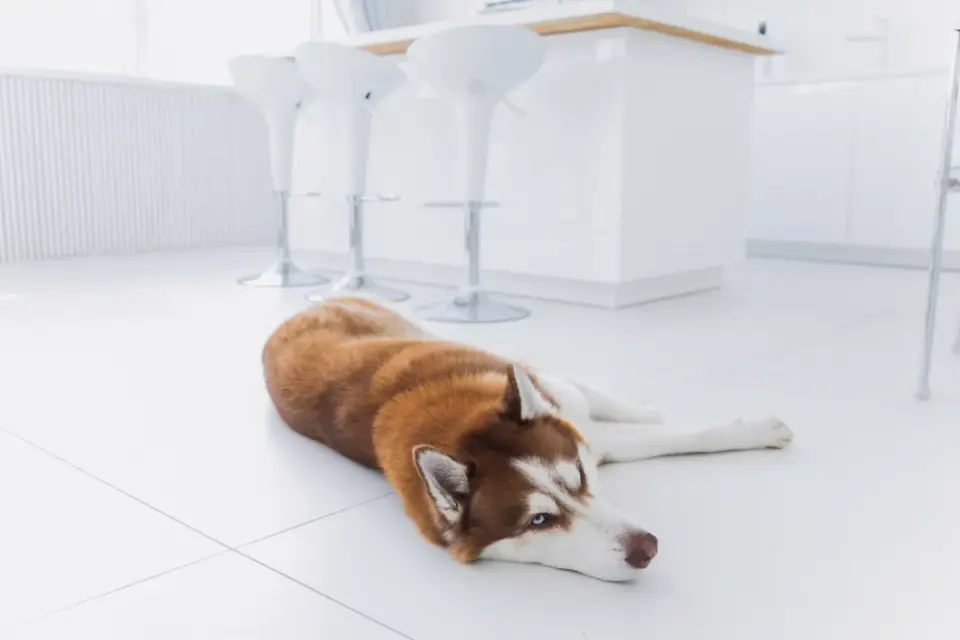
A lot of owners assume one bath mat by the water bowl solves the problem. It doesn’t, and here’s why: dogs don’t slip in one spot, they slip along a route — bed to bowl, bowl to door, door to the yard. A single rug patches one square foot of a much longer hazard. According to the Animal Medical Center, wooden and tiled floors are frequently hazardous for dogs, and repeated slipping can predispose them to soft-tissue strains and flare-ups of arthritic joints — which is exactly the cycle I saw with Gunther. A rug that isn’t secured, or that only covers a fraction of the walked path, doesn’t break that cycle; it just moves where the slip happens.
Building the setup, not just buying the mat
Here’s the sequence I actually walk owners through, in the order it tends to pay off fastest:
- Trim the nails first. Long nails lift the pad off the ground and reduce the surface contact that gives a dog grip; keeping nails short is one of the simplest, most effective changes an owner can make. If you’re not comfortable trimming at home, your vet or groomer can do it every two to four weeks.
- Lay continuous runners, not spot rugs. Cover the actual walked path — bed to bowl, bowl to door — with rubber-backed runners secured so they can’t slide out from under a moving dog.
- Consider toe grips or paw wax for problem dogs. Dr. Buzby’s ToeGrips are one option a rehabilitation service may prescribe to increase paw-to-floor contact; paw wax is another that can add grip without changing the nail.
- Support the joints underneath. If a dog is slipping because a hip or knee is sore, traction aids are treating the symptom, not the cause — that conversation belongs with your veterinarian.
- Reassess after two weeks. Watch for the markers that told you something was wrong in the first place: hesitation at doorways, a wider stance on tile, or skipping trips to the water bowl.
If mobility is already a bigger concern than a slick kitchen floor, it’s worth reading about toe grips vs paw wax vs nail grinding for traction in more depth, and — for dogs with more significant joint or mobility limits — how other households have adapted routines in our guides on keeping a wheelchair (cart) dog comfortable at home and keeping a paralyzed dog clean and comfortable.
A dog that stops crossing the kitchen isn’t being stubborn.
That single behavior change — refusing a floor they used to cross without a thought — is often the clearest early sign an owner gets that something hurts.
Where I land
I don’t think traction gear is optional for most tile-and-hardwood households, and I’ll defend that even though I know some owners see it as overkill for a dog that “seems fine.” The strongest counterargument I hear is that a young, healthy dog with good muscle tone doesn’t need runners or nail maintenance beyond routine care — and for a genuinely young, structurally sound dog on a mostly carpeted floor plan, that’s fair. But most of the dogs I see slipping on tile aren’t young. They’re middle-aged to senior, they have some early joint change, and the tile is exposing a weakness that was already there. In those dogs, waiting until there’s a visible limp means you’re managing an injury instead of preventing one.
I saw this shift firsthand with a fourteen-year-old terrier mix, about eighteen pounds, whose owner had assumed her hesitance at the hallway threshold each morning was just “old dog stubbornness.” Over roughly a month, once the nails were trimmed short and runners went down the full hallway route, the dog started crossing that threshold at a normal pace again, first thing in the morning, without the pause. I can’t promise that outcome for every dog — pain has more than one source, and a rug won’t fix an arthritic hip on its own — but for a dog whose main barrier was traction, it’s the change I see most often.
So where does that leave a busy owner standing in their kitchen tonight? Probably deciding whether tonight is the night the nail clippers finally come out.
For related context, read Indoor Cooling Setup for a Flat-Faced Breed.
For related context, read Keeping a Dog Cool at Home During a Power Outage.
Frequently asked questions
Is it normal for a dog to slip occasionally on tile?
An occasional slide on a wet or freshly mopped floor isn't unusual, but repeated slipping in the same spots, or a dog that starts avoiding certain floors, is worth mentioning to your veterinarian — it can point to sore joints or overgrown nails rather than "clumsiness."
Do dog socks work as well as runners?
Socks can help in the moment, but most dogs tolerate continuous rugged pathways better long-term, and socks alone don't address long nails or an underlying joint issue.
How often should nails be trimmed to help with traction?
Roughly every two to four weeks for most dogs, though the right interval depends on how fast your individual dog's nails grow and how much natural wear they get.
Sources
- Traction Control: Tips for Preventing Dogs from Slipping and Sliding — Animal Medical Center
- 15 Tips to Stop Your Dog Slipping on the Floor — Dr. Buzby's ToeGrips