
Lawrence walks Kaylee, his 2-year-old spayed Cocker Spaniel, around the block in West Covina and spends the whole loop wrestling a thin, slippery leash that burns when she lunges toward pigeons at about 15 feet.
Most owners assume a training problem calls for a training-labeled leash, when the real problem is usually fit for the job: the wrong length for the setting and a material you hate to hold. A dog training leash does not train by itself. Your timing, your reinforcement, and how comfortably you can hold on while you teach are what change behavior, a point the American Veterinary Society of Animal Behavior makes clearly in its position statements on humane training methods.
That expectation matters. A leash may help support clear communication and low-stress handling by keeping a dog safely close enough to earn reinforcement, but it will not fix pulling, lunging, or recall on its own. Plan on two to three short practice sessions per day for a few weeks before loose-leash walking starts to feel like a baseline habit rather than a workout.
The leash is not the lesson
Think structure and function. The leash has two jobs: keep the dog safely connected and give you a comfortable way to guide without hurting the neck, shoulder, or your own hands. Learning comes from what happens while connected — marking and rewarding the position you want, managing distance from triggers, and ending before frustration builds.
Retractable leashes and very long lines have a place for sniffing and decompression in open space, but they make teaching harder on sidewalks. The line stays tight, the dog learns pressure means forward, and your cue arrives late down 16 feet of cord. The American Kennel Club notes the same trade-off in its overview of leash types: more freedom for exploration, less control for teaching close-range skills.
Short is not better either.
A 2-foot traffic handle is useful for crossing a street, but it holds a dog too close to learn how to choose to stay near you.
What length actually does for learning
For everyday training, length sets the size of the classroom.
A 4- to 6-foot fixed leash covers most pet-dog skills: name response, sit and down around distractions, settle on a mat, and loose-leash walking. Six feet gives a medium dog room to sniff and check in without hitting the end with every step. Four feet suits crowded sidewalks, small dogs, or owners who want less leash to manage. Hold the middle with both hands and let a small J of slack hang — slack is information that tells you the dog is choosing to stay with you.
A 10- to 15-foot long line is a second tool, not a daily driver. Use it in a park or field to practice recall, find-it games, and polite greetings from a distance. Keep it off sidewalks and never attach it to a collar for a dog that hits the end at speed; a well-fitted back-clip harness spreads pressure more comfortably.
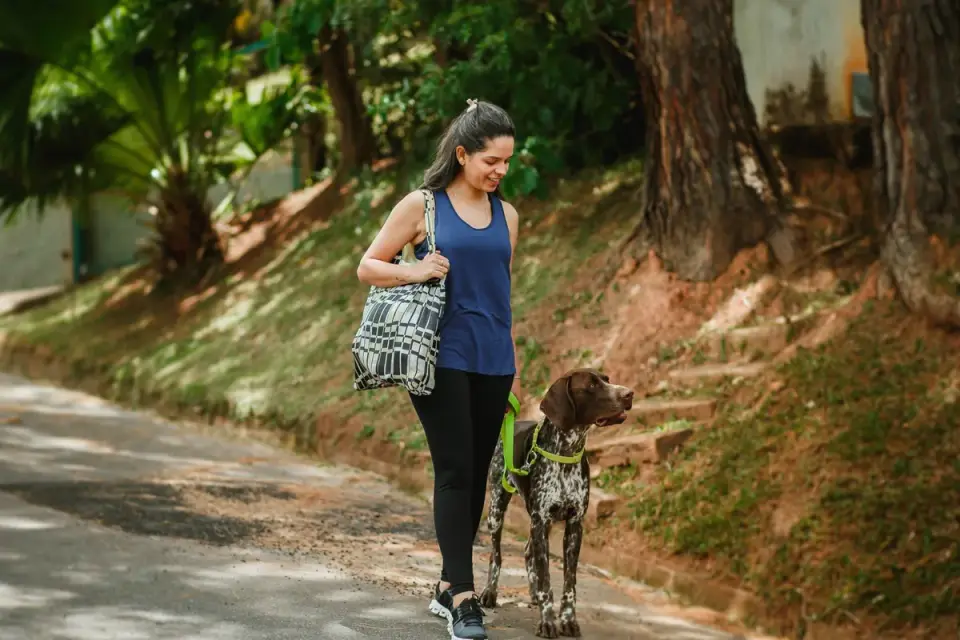
If you take a class, ask the instructor what length they prefer before you buy. Many programs for loose-leash work pair a 6-foot leash with a treat pouch routine, and our guide to How to Use a Treat Pouch Effectively walks through that timing. If you are deciding between formats, Group Classes vs. Private Training vs. Online Dog Training: How to Choose can help you match the setting to the length you will need.
Material matters more to your hands than to your dog
Dogs do not care much about webbing versus rope. Hands do.
Flat nylon or polyester webbing is light, washable, and affordable, and it works well for most training. Look for a width that fills your grip without folding — about 3/4 inch for small dogs like a Havanese mix and 1 inch for stronger pullers. Soft, broken-in webbing with rounded edges may help support comfort and reduce rope burn.
Climbing-rope style leashes are durable and easy to grip, but thicker rope adds weight for a small dog and can be stiff around a post. Leather softens nicely with use and is gentle on hands, though it needs more care and costs more up front. Chain is noisy, heavy, and hard to hold; slip-style leashes that tighten around the neck make low-stress handling harder and are best avoided for routine teaching.
Hardware counts. A swivel bolt-snap that turns freely prevents twisting, and the clip should match the dog: small and light for toy breeds, sturdy and locking for large, strong dogs. Test this in the store with gloves on if you walk early on cold mornings.
A comfortable leash keeps you practicing.
That is the whole argument. The leash you like to hold is the one you will use for the extra five minutes of reward-based practice that builds behavior over time. Pick length for the lesson, pick material for your hands, and let consistent reinforcement do the training.
Frequently asked questions
What length leash is best for training a dog to walk nicely?
For most owners, a fixed 4- to 6-foot leash works best because it keeps the dog close enough to reward and easy to guide on sidewalks. Save 10- to 15-foot long lines for recall practice in open, safe areas.
Are retractable leashes good for training?
They are poor tools for teaching loose-leash walking or recall because constant tension teaches pulling and cues travel slowly down a long cord. Use them only for supervised sniff walks in open space, away from roads and other dogs.
Sources
- Humane Dog Training Position Statement — American Veterinary Society of Animal Behavior