
Most owners ask if their dog is ready for sports by watching excitement at the park, but muscle fatigue and cartilage load tell a more honest story than tail wagging. A dog can love to run and still lack the aerobic base, joint maturity, and movement control that jumping, weaving, sprinting, and swimming demand.
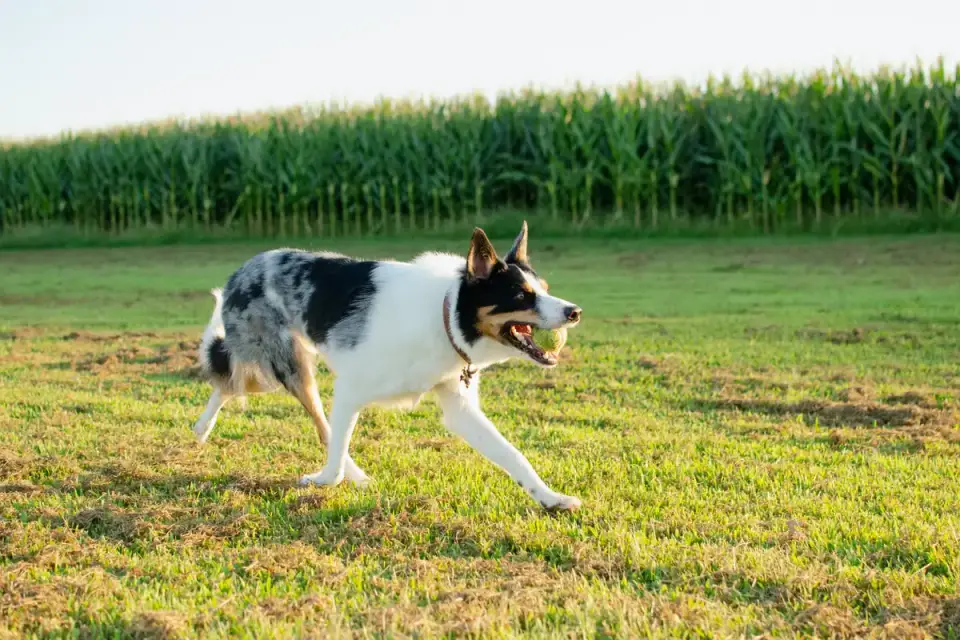
A 2-year-old Border Collie mix weighing 42 pounds came to mind as the classic decision point. She could chase a ball for 30 minutes without slowing, held a sit-stay around other dogs, and recovered to a soft pant within five minutes back at the car. Her owner was weighing novice agility against dock diving, concerned that her tight turns on grass looked fast but uncontrolled, with occasional wide overshoots on the left side by week two of backyard jumps. That combination — mature skeleton, solid recall, quick recovery, but unpolished deceleration — made her a good candidate to start foundations, not full-height competition.
Conditioning decides more than desire does
Skeletal muscle adapts in weeks, while tendon, ligament, and articular cartilage adapt over months because blood supply is sparse and collagen turnover is slow. That mismatch explains why a dog looks fit before the joints are prepared for repetitive impact.
The American Kennel Club sets 15 months as the minimum age for agility competition entries, which reflects growth-plate closure and training maturity rather than talent. Large-breed growth plates, especially around the shoulder and stifle, often remain open until 12 to 18 months. Early repetitive jumping or hard-deceleration work loads open physes and immature cruciate support structures in ways easy flat-ground play does not.
My position is direct: prioritize 8 to 12 weeks of general conditioning before sport-specific loading. That means brisk leash walks, controlled hill work, cavaletti poles at elbow height or lower, core balance on stable surfaces, and one rest day between harder efforts. Food therapy and complete everyday nutrition do most of the work here; a joint supplement may help support normal cartilage metabolism and recovery, but it cannot substitute for gradual loading.
The strongest counterargument is that talented young dogs get bored with foundations and owners fear losing momentum. That concern is valid for high-drive adolescents. I still land on delayed impact because boredom can be managed with nosework, rally footwork, and low-impact drive games, while a growth-plate injury or early cruciate strain changes a whole career.
Short version: build the engine before you test top speed.
A growth and behavior screen before you enter
Sport readiness is orthopedic, cardiovascular, and behavioral. A dog needs all three.
Use this same-day screen at home. Walk 20 minutes, then trot 5 minutes on leash and watch breathing, gait, and focus. A ready-for-foundations dog recovers to easy nasal breathing within 5 to 10 minutes, moves symmetrically at walk and trot, accepts handling of feet and hips without guarding, and can disengage from another dog or thrown toy on cue. Limping, bunny-hopping, sitting out, prolonged open-mouth panting past 15 minutes, or next-day stiffness means conditioning first and a veterinary check before progressing.
I recall a 10-month-old Labrador Retriever at 68 pounds whose owner had built backyard weave poles and a full-height jump. By day 10 of daily practice he started cutting the last weave entry short and bunny-hopping up the stairs that evening, subtle signs the owner first read as laziness. We stopped jumping entirely for three weeks in favor of leash hikes, sit-to-stand repetitions, and recall games, and his stair pattern normalized. The tradeoff was real — he lost two weeks of skill rehearsal — but the failed approach clarified the lesson: daily impact outpaced tendon and growth-plate readiness, and enthusiasm masked early fatigue.
Dogs with brachycephalic airways, body condition scores above ideal, prior lameness, or age under 12 months for jumping sports need veterinary clearance. That caution applies doubly to sprint and cold-water sports, where thermoregulation and joint load spike quickly. If you enjoy trail running together, our guide to Canicross: Running Connected to Your Dog details age, harness fit, and pacing checks that transfer well to other timed sports. For winter conditioning, see Cold-Weather Activities to Keep Your Dog Active.
Food, joint nutrients, and recovery in plain terms
Working muscle burns glycogen, generates heat, and produces microdamage that repairs during rest. Connective tissue depends on steady amino acid supply, omega-3 fatty acids, vitamins, and minerals to maintain collagen and manage normal post-exercise inflammation. No supplement builds skill, yet diet quality shapes how completely a dog bounces back between sessions.
Feed a complete, life-stage-appropriate diet first, keep body condition lean enough to feel ribs under light cover, and offer water before, during, and after training. On training days, a small, digestible meal 3 to 4 hours beforehand supports energy without gastrointestinal upset. After hard work, rest, shade, and rehydration matter more than any powder.
Where supplement science fits is narrow and supportive. Glucosamine and chondroitin sulfate are structural components of cartilage matrix, and the NIH Office of Dietary Supplements summarizes their study in joint health as mixed but biologically plausible for supporting joint structure. Omega-3s EPA and DHA from fish oil may help support a normal inflammatory response after exercise. These ingredients may help support mobility and recovery as part of food therapy, not rebuild damaged cartilage or prevent injury on their own. Choose products with transparent sourcing and quality controls, introduce one change at a time, and track response over 4 to 6 weeks.
The American Veterinary Medical Association emphasizes gradual progression and owner observation for exercise safety, which aligns with sports-medicine practice: increase only one variable at a time — duration, intensity, or technical difficulty.
A 7-year-old Pug weighing 22 pounds illustrates the edge case that changes the plan. He had clean bloodwork, mild hind-limb stiffness after naps, and excellent focus for rally obedience, but he overheated quickly and his trot shortened after about eight minutes on warm days three weeks in to class. Rather than pushing toward agility, his owner pivoted to rally and short scent games with cooling breaks, and his next-day energy stayed bright. Age did not disqualify him from competition; it redirected him toward a sport where airway anatomy and recovery capacity, not speed, defined readiness.
Good manners around other dogs matter as much as fitness. Trial environments pack barking, food, and tight crating into one building. Practice from our Dog Park Etiquette Every Owner Should Know — recall past distractions, settle on a mat, polite leash passing — predicts trial-day control better than any backyard time. If fetching drive is part of your plan for dock or flyball, How to Teach a Dog That Won’t Fetch: A Step-by-Step Plan Grounded in Real Dog Behavior can help you test motivation before you invest in equipment.
Talk with your veterinarian if you notice lameness lasting more than 24 hours, swelling, reluctance to jump or climb, coughing or noisy breathing during effort, or collapse. Those signs belong in an exam room, not in the next training session.
Frequently asked questions
What age can my dog start competitive sports?
Many clubs allow foundations and rally skills under 12 months with no jumping, but AKC agility competition requires 15 months. Wait until growth plates close — often 12 to 18 months in large breeds — before repetitive jumps, weaves at full spacing, or sprint work, and get veterinary clearance first.
How do I know if soreness is normal or a vet visit?
Mild tiredness that resolves overnight with normal appetite and gait is typical during conditioning. Schedule a veterinary exam for limping past 24 hours, joint swelling, yelping, reluctance to rise or jump, breathing difficulty, or stiffness that worsens across sessions.
Do joint supplements make a dog ready sooner?
No. Complete nutrition, lean body condition, and gradual loading create readiness. Glucosamine, chondroitin, and omega-3s may help support normal joint structure and recovery, but they do not accelerate growth-plate closure or replace conditioning.
Sources
- AKC Agility: Rules and Eligibility — American Kennel Club
- Glucosamine and Chondroitin — NIH Office of Dietary Supplements
- Exercise and Activity for Pets — American Veterinary Medical Association